Vice-President Radhakrishnan Marks 79th Hyderabad Liberation Day, Emphasises Nation-Building

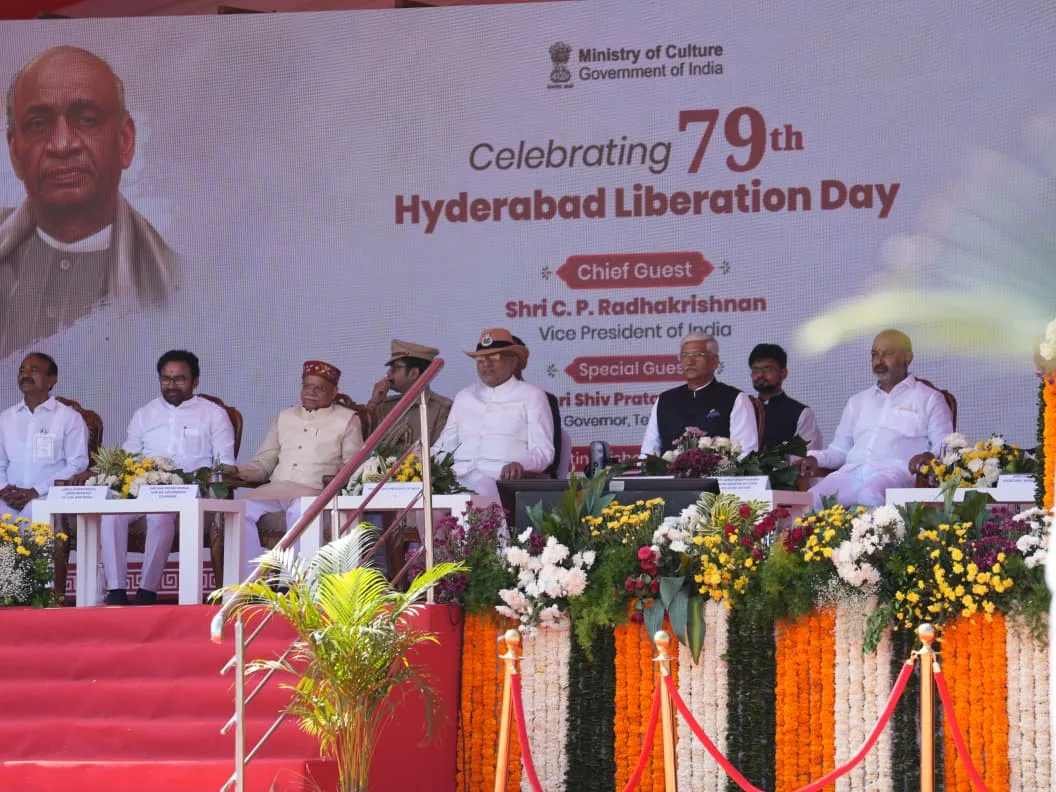
September 17 is not merely a historic date marking the liberation of Hyderabad, but a reminder of the ongoing journey of nation-building and the values that bind India together, Vice-President C. P. Radhakrishnan stated in Hyderabad. He was speaking as the Chief Guest at the 79th Hyderabad Liberation Day celebrations held at the Parade Ground in Secunderabad, Telangana.
Addressing the gathering, the Vice-President noted that September 17, 1948, marked the conclusion of a decisive chapter in the history of independent India. This milestone was achieved with the integration of the erstwhile Hyderabad State into the Indian Union following the events of September 1948 and Operation Polo. He described the liberation as a monumental event that reflects the challenges faced by a young nation in uniting people from diverse political backgrounds.
The Vice-President remarked that the story of Hyderabad is one of statesmanship, courage, and sacrifice. He added that this history was followed by the larger, continuing task of establishing a constitutional democracy where every citizen is afforded an equal place.
Tributes to National Leaders and Freedom Fighters
Recalling the contributions of Sardar Vallabhbhai Patel to national integration, the Vice-President highlighted his extraordinary responsibility as the first Home Minister and Minister for States. He noted that Sardar Patel consolidated hundreds of princely states into a single Union while the country was still recovering from Partition, laying the foundation for a unified nation.
Drawing parallels between different eras of India's development, the Vice-President said that Mahatma Gandhi and Netaji Subhash Chandra Bose played pivotal roles in the freedom struggle, while Sardar Patel unified the princely states. He added that Prime Minister Narendra Modi is now playing a key role in guiding the country toward becoming a developed nation by 2047.
Paying tribute to the public struggle behind the Hyderabad movement, the Vice-President acknowledged the students, intellectuals, writers, social workers, political activists, farmers, and ordinary citizens who endured imprisonment, violence, and hardship. He paid homage to patriots such as Ramji Gond, Turrebaz Khan, and Komaram Bheem, stating that their courage demonstrates how history is shaped by ordinary citizens who refuse to accept injustice.
Role of Armed Forces and Cultural Ceremonies
The Vice-President emphasised that while political integration can bring territories together, it is constitutional democracy that unites citizens. He stressed that national unity must be sustained through equal rights, dignity, and opportunity, rather than geography alone. He added that India's unity does not require uniformity, as citizens who speak different languages and follow different traditions remain bound by the Constitution.
He also recognized the role of the Central Armed Police Forces in safeguarding the territorial integrity of the nation during 1947–48 and in integrating the princely states. He further acknowledged their ongoing contributions to combating Left-Wing Extremism in states such as Telangana, Chhattisgarh, and Jharkhand.
During the event, the Vice-President visited the War Memorial to lay a wreath and pay tribute to fallen soldiers. He also inspected the parade, witnessing the March Past and various cultural performances. He remarked that the legacy of Hyderabad serves as a reminder that integration must lead to inclusion, and patriotism must find expression in service to the nation.
Political Addresses and Historical Reflections
Union Minister of Culture and Tourism Gajendra Singh Shekhawat also addressed the gathering, stating that the day offers an opportunity to draw inspiration from the sacrifices and dedication of the freedom fighters and heroes of the Hyderabad liberation struggle.
Union Minister for Coal and Mines Kishan Reddy paid tribute to the martyrs who fought against the autocratic rule of the Nizam and the actions of the Razakars. He criticised the Congress and BRS parties, alleging that the historical atrocities and suffering of the people under the Nizam's rule had been suppressed for years due to vote-bank politics and fear of the Majlis party.
Reddy challenged assertions that the Nizam's governance was beneficial, questioning why prominent figures such as Vande Mataram Ramachandra Rao, Bhagya Reddy Varma, Komaram Bheem, Chakali Ailamma, Doddi Komuraiah, and P. V. Narasimha Rao had to fight against the administration. He also questioned why rural populations had to build defensive bastions in their villages and why the Indian Army had to intervene with tanks in independent India.