Sonia Gandhi's Second Coming as Writer and Critic

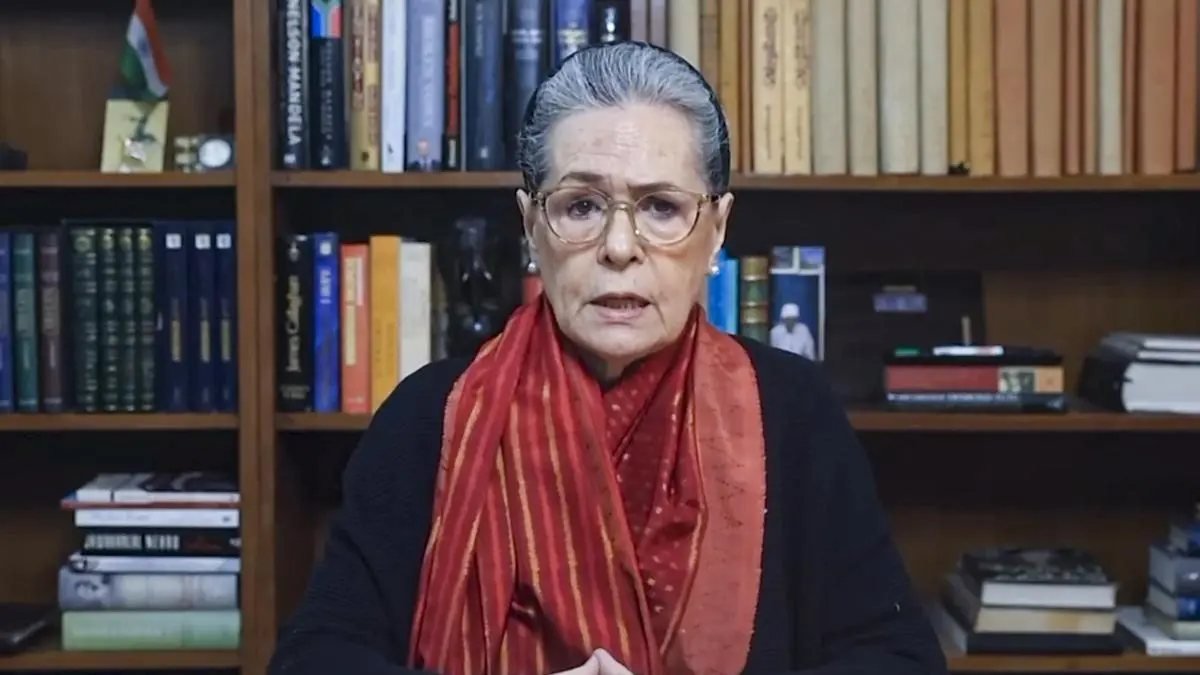
The Congress leader's newspaper columns have given her a new platform to challenge Modi's politics, defend India's constitutional values, and reclaim a public voice after stepping back from active politics.
From Politics to Writing
Sonia Gandhi's memoir, Belonging: A Journey of Love, marks her second coming, following a series of newspaper essays that have made her one of the sharper critics of the Modi government.
Even before the memoir made headlines, Gandhi had taken to publishing articles in newspapers at a frequency never seen before in her political career—as many as 12 pieces since June 29, 2024.
Perhaps writing is, for Gandhi, a substitute for what she can't do at her 79 years of age: crisscross the country to mobilise people against Hindutva and resurrect the Congress' lost glory.
Challenging Modi's Politics
Her articles are blistering attacks on Modi's substance and style of governance. They also invariably remind readers of India's shift away from the constitutional and civilisational values that had defined its being until Modi came to power in the summer of 2014.
Gandhi set the pace with her very first piece, “Preaching Consensus, Provoking Confrontation”, published on June 29, 2024. She decoded the 2024 Lok Sabha verdict as a “personal, political, and moral defeat for a Prime Minister who had awarded himself a divine status during the campaign”.
She has been remarkably prescient, too. In that June 29 piece, she devoted just a paragraph to the National Eligibility cum Entrance Test “scandal”, yet her analysis foretold the tumult over it two years later.
Defending India's Constitutional Values
Her instinct to anticipate the Modi government's moves is borne out in a piece she wrote on its decision to advance women's reservation and conduct delimitation based on the 2011 Census.
The government justified this move by claiming that the counting of caste would delay the publication of the Census 2027—and, therefore, also the implementation of women's reservation.
This is not true, argued Gandhi, pointing to the government's boast that the findings of the Census would be available in 2027 itself, because of it being conducted digitally.
Exposing Policy and Principles
Four of Gandhi's pieces have been on India's muted response to Israel's genocidal killings in Gaza, its two attacks, in 2025 and 2026, on Iran, and the assassination of its Supreme Leader, Ali Khamenei.
In them, she repeatedly cautioned that India's silence on the genocide is “not neutrality”, and that it could be interpreted as “complicity” in the massacre.
Prime Minister Narendra Modi and Israeli Prime Minister Benjamin Netanyahu at a joint press meet in Jerusalem on February 26, 2026.
Reclaiming a Public Voice
Her feisty newspaper pieces are now set to be followed by her memoir. Her refusal to accede to the demand of Penguin Random House India to excise references to Modi and the RSS from her memoir turns her into both a victim of the culture of censorship—and a doughty opponent of it as well.