Telangana's Special Intensive Revision Raises Questions About Exclusion and Fairness

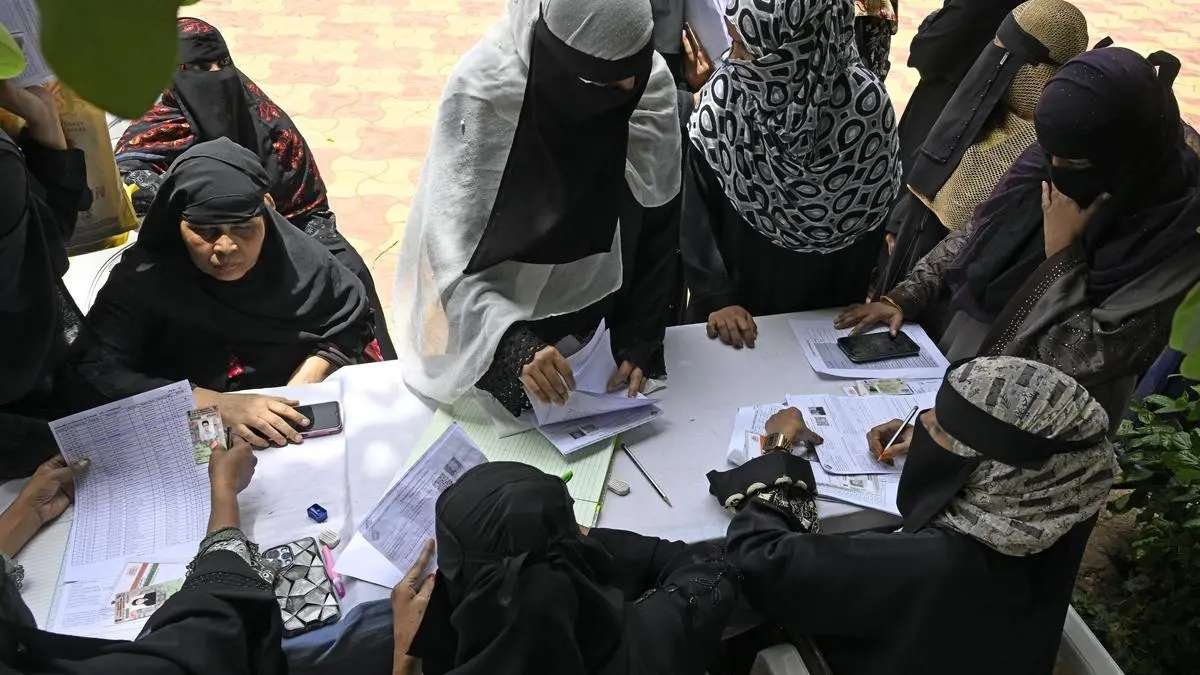
The State's 3.38-crore-strong electorate has been cut down to 2.65 crore. Even among those in the draft roll, 35 per cent have been flagged for “logical discrepancy”, raising serious questions about the process’s motive and fairness.
Residents Verify Enumeration Forms
Residents verify enumeration forms with booth level officers during the Special Intensive Revision of electoral rolls in Kishanbagh, Hyderabad on July 8, 2026. | Photo Credit: RAMAKRISHNA G.
For nearly a month, 29-year-old Shahida’s (name changed) family has had a singular obsession: to gather enough documentation to make sure they remain on the final electoral roll of the ongoing Special Intensive Revision (SIR) in Telangana.
Shahida and her six siblings each received a “logical discrepancy” notice after the draft electoral roll was published on August 17. The software flags an elector as “suspicious” if six or more people in a household are mapped to the same father in the 2002 roll. Each sibling must now attend a hearing and prove they are the son or daughter of the man listed as their father.
Shahida has been asked to submit four documents—which she has, having completed high school. Her siblings, who are school dropouts, have barely one or two documents each and are now trying to secure more by spending their hard-earned wages.
Chaos Ensues Due to Lack of Transparency
Chaos ensued because the list of people who received notices was not published on the website of the Chief Electoral Officer (CEO) of Telangana, C. Sudharsan Reddy, until September 8. Frontline found that several overburdened BLOs did not visit houses to deliver notices. Many residents did not know if their names featured among those who received notices nor how to check this.
At the time of writing this story, official sources acknowledged that several thousand electors had missed their first and rescheduled hearing dates.
Disproportionate Burden on Marginalised Electors
The administrative categorisation of logical discrepancies does not take into account lived realities such as child marriages, large families, and poor documentary trails. While the fact that VIPs (including Telangana’s CEO) also received notices is often cited as proof that the ECI’s system does not discriminate by class, caste, or religion, it does not negate the disproportionate burden that marginalised electors such as Shahida bear while trying to gather evidence to prove their citizenship.
Some of the case studies Frontline found involve electors who were flagged as unmapped and received notices even though their BLO-signed enumeration forms show that they had indeed provided the details required to map to the 2002 roll. Now, they have to re-establish the same link with additional documentation.
Questions Raised About the Veracity of the ASDD List
Telangana’s 21.7 per cent (73 lakh) ASDD deletions are the highest in India, narrowly ahead of Maharashtra at 21.14 per cent. In Telangana, questions have been raised about the veracity of the ASDD list by both politicians and civil society organisations because of the scale and the opacity of the process.
Frontline traced the cases of eight electors marked “untraceable/absent” and deleted from the draft electoral roll. All eight shared evidence—signed acknowledgements from BLOs—proving that they had submitted their enumeration forms and were not untraceable/absent.
Discretionary Decision-Making and Anxiety Among People
Responding to what happens to such Form 6 applications, Reddy said: “People can submit ID cards etc. Based on that the ERO or AERO will take a call. It [the link with the 2002 rolls] is needed, but if it is not possible, then there is no other go. They need to search and probe a little and accordingly take a call.” This kind of discretionary, case-by-case decision-making has furthered the anxiety among people.
ECI officials have repeatedly asserted that no eligible voters will be left behind.
Systemic Issues and Technical Deficiencies
Abdul Mujeeb of the NGO Adalah Foundation told Frontline:“Several of the challenges were created by systemic issues such as ambiguities in how to fill the enumeration form, legacy data inconsistencies, transliteration errors, inadequate training, and technical deficiencies in the BLO app.” The BLO app’s page on Google Playstore contains hundreds of negative reviews about its many technical glitches.
When Frontline visited constituencies across Hyderabad, it found an inconsistent pattern relating to the number of documents demanded from people who are attending the logical discrepancy hearings. It is unclear whether the requirement for multiple documents is imposed by officials or the software and how “adequate evidence” is defined.
For instance, in an upscale locality in west Hyderabad, an official accepted two sets of documents as sufficient for a mapping issue with the 2002 rolls. The same notice warranted a minimum of three documents in Bahadurpura in the old city. If a standardised protocol exists, it has not been made publicly available.
Accountability and Transparency
A. Suneetha, a researcher and feminist activist who is part of the coalition Telangana Voter Rights Forum, observed that in some cases, the problem started during the enumeration phase. “In Bholakpur, we found a house where some members didn’t receive an enumeration form. The family that owns the house has lived there for nearly three decades and voted in 2023, but some of them are now being asked to file Form 6. Is accountability being passed on to the electors? How did they end up not being on the draft list? No election officials, the ECI, or the CEO is being made accountable for this,” she said.
In July, speaking to Frontline about whether the ECI was using AI for the SIR, Reddy said: “To what extent ECI is using it, I don’t know. I can only guess they have been using it for chalking out the anomalies [logical discrepancies].” Speaking to Frontline after the publication of the draft roll, he confirmed that the notices were “AI-generated”.