
Two Killed as Firefighting Helicopters Collide Mid-Air in Greece

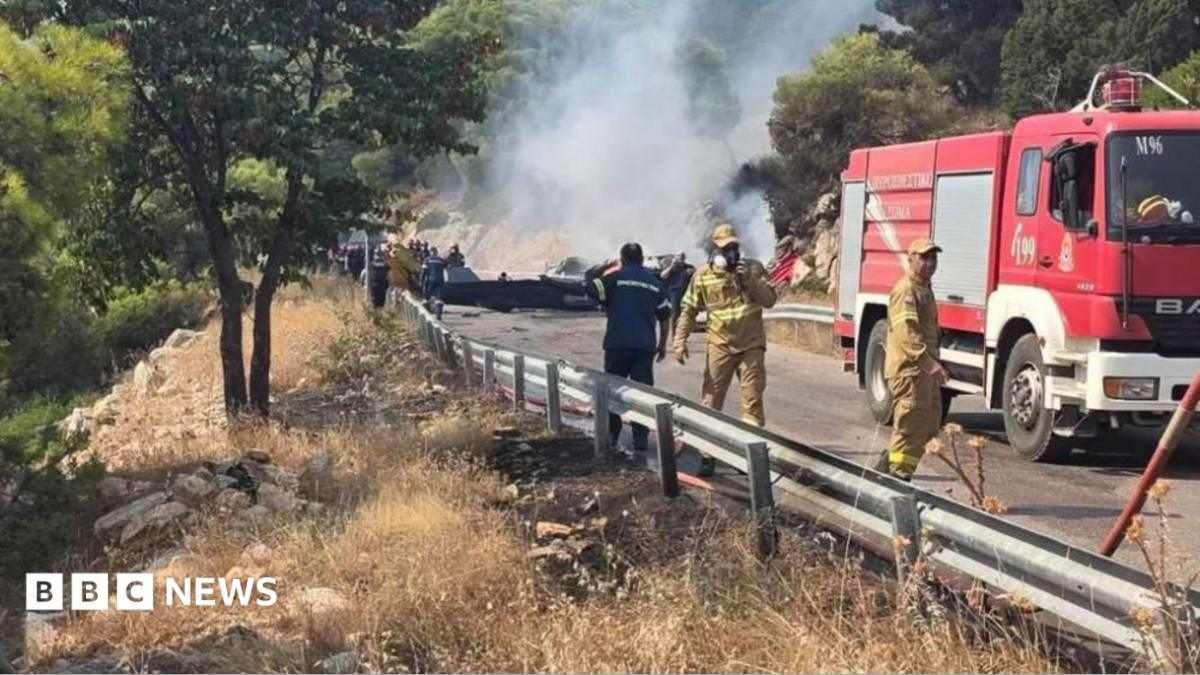
Two crew members have died and two others survived after two firefighting helicopters collided mid-air in Greece. The incident occurred while the aircraft were actively battling a large wildfire on the border of the Attica and Boeotia regions.
The fatalities have been identified as a Danish pilot and a Greek fire service liaison officer. The two survivors, who were on board the second helicopter, include a British pilot and a Greek coordinator. The collision took place approximately 65 kilometers (42 miles) west of the Greek capital, Athens.
Video footage of the incident captured the moment one of the leased Bell helicopters struck the propellers of the other. Following the impact, the struck helicopter burst into flames and crashed into a nearby ravine. The second helicopter managed to execute an emergency landing.
Emergency Landing and Survivor Rescue
The second Bell helicopter involved in the mid-air collision successfully landed in an area characterized by low vegetation. A source from the Greek civil protection ministry confirmed to the BBC that the two individuals on board escaped the crash with only minor injuries.
The survivors—the British pilot and the Greek fire service liaison officer—remained conscious throughout the ordeal. According to reports from Greece's Ekathimerini news website, they immediately reported the collision to emergency services and successfully guided rescue teams directly to the crash site.
Both survivors were subsequently admitted to a hospital, where they were scheduled to remain under observation for 24 hours as a precautionary measure. The civil protection ministry source noted that the British pilot was a private contractor hired specifically for the wildfire season, clarifying that his deployment was not part of an official exchange program between the United Kingdom and Greece, nor did it stem from a formal request for assistance by Athens. The names of the four crew members involved have not been publicly released.
Bell Helicopters Grounded Following Protocol
In the wake of the fatal accident, Greek authorities have grounded all Bell helicopters across the country. A civil protection ministry source stated that this measure was taken in accordance with established safety protocols.
Greek Prime Minister Kyriakos Mitsotakis expressed his condolences publicly, sharing his "deepest sorrow" over the tragic incident. In a post on the social media platform X, Mitsotakis stated that the loss of the Greek coordinator and the Danish pilot "fills us all with grief" and extended his sympathies to the families of the victims.
Despite the grounding of the Bell helicopter fleet, aerial firefighting operations in Greece are continuing. Emergency services are utilizing other aircraft, including Erickson Air-Crane and Chinook helicopters, alongside Canadair water-bombing planes, to combat the ongoing blazes.
Widespread Wildfires and Climate Conditions
The collision occurred amidst a broader wildfire crisis in Greece, where emergency services have been engaged in what local media describes as a "titanic battle." More than 500 firefighters have been working over a 72-hour period to control fires burning across a wide swathe of territory, including Porto Germeno, Psatha, Fokida, Megara, and Kefalonia.
The situation in Greece reflects a wider European struggle with extreme summer weather. Earlier in the week, France and Spain also faced massive wildfires, particularly near Bordeaux and Madrid. While those fires have since been contained, they continue to burn, and some of the estimated 300,000 people who were evacuated have begun returning to their homes.
Experts note that while most wildfires are initiated by human activity—either accidentally or intentionally—environmental conditions are exacerbating their severity. A mild and wet winter in Greece encouraged significant vegetation growth. Subsequent successive hot spells dried out this vegetation, creating a vast amount of dry fuel that has intensified the current wildfire season.