Trump Signs Executive Order to Rename Lake Ontario as Lake America Amid Trade Dispute

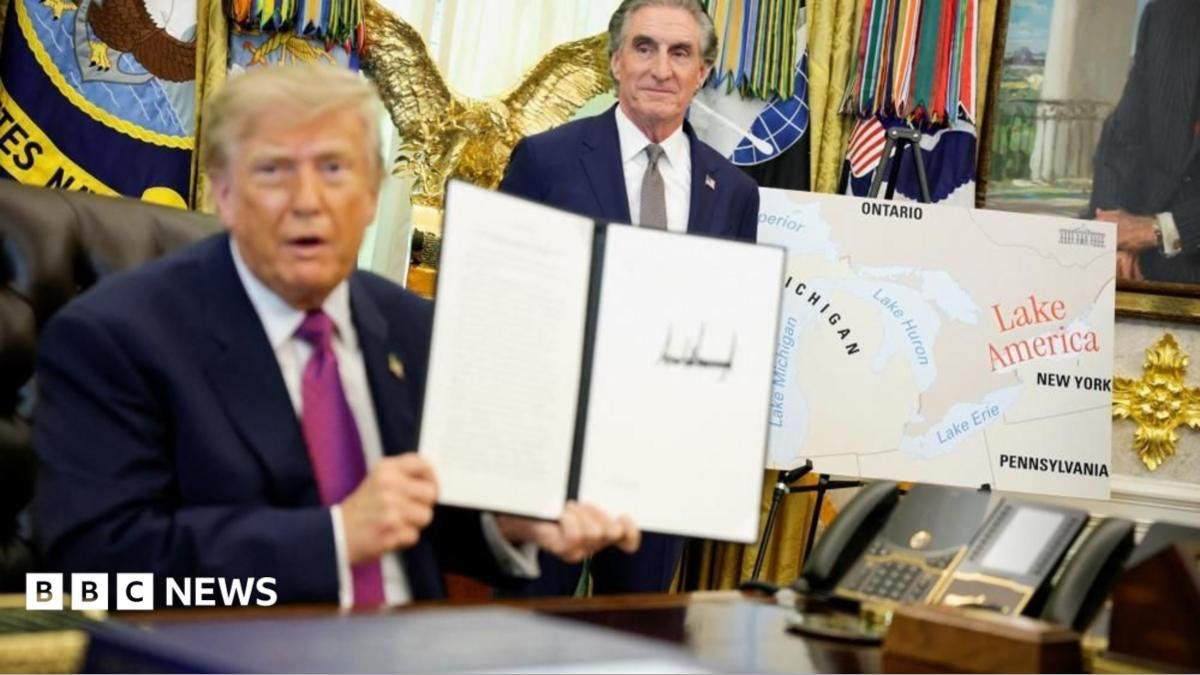
US President Donald Trump has signed an executive order seeking to rename Lake Ontario to "Lake America." The decision follows the collapse of trade negotiations between the United States and Canada late last week, which led to the US imposing new 50% tariffs on $20 billion (C$28 billion) worth of Canadian goods. In response, Canada has announced plans to implement "dollar for dollar" counter-tariffs next month.
President Trump had repeatedly posted threats on social media about renaming the lake, which is one of the five Great Lakes straddling the border of both nations. On Thursday, Trump declared the change was "official, effective immediately" and stated that his administration had "filed all the necessary papers, documents" to enact the modification.
Canadian Officials Reject Name Change
Canadian Prime Minister Mark Carney criticized the move, pointing out that the name Lake Ontario dates back more than 400 years, predating both the formation of the Canadian Confederation and the US Declaration of Independence.
"We know that the United States is changing. Their trade relations, their foreign policy, their national monuments, their hydronyms," Prime Minister Carney wrote in a social media post on Thursday. "Canadian women and men also know that things must be called by their name, and this lake is called Lake Ontario – today and forever."
Other Canadian political figures also dismissed the executive order. Tim Houston, the Premier of Nova Scotia, remarked on Thursday, "We're into some real foolishness now. It's Lake Ontario, buddy." Canada's Industry Minister, Melanie Joly, stated on Tuesday, "We'll always call it Lake Ontario."
Precedent and Legal Implications
This is not the first time President Trump has attempted to rename a shared body of water. Upon taking office in 2025, he signed a similar executive order to rename the Gulf of Mexico to the "Gulf of America." Mexico rejected the change, maintaining that a single nation cannot unilaterally rename a shared body of international water.
The previous renaming led to a legal dispute between Mexico and Google. Currently, Google Maps users in the US see "Gulf of America," while users in Mexico see "Gulf of Mexico." Users in other countries see "Gulf of Mexico (Gulf of America)."
Additionally, the White House previously blocked Associated Press reporters from presidential events due to the news agency's refusal to use the name "Gulf of America" in its reporting. The Associated Press filed a lawsuit against the Trump administration, and the legal battle remains ongoing.
Administrative Scope and Geographic Origins
There is no universally recognized international body responsible for designating the names of international waters. While a US president holds broad authority over how the US government officially recognizes landmarks, other nations are not obligated to adopt these changes.
Trump's latest executive order directs the US Department of the Interior to update the Geographic Names Information Service, which serves as the official domestic repository for geographic names in the US. Canada, however, does not recognize domestic name changes made by foreign governments.
Lake Ontario is the smallest of the Great Lakes and borders the Canadian province of Ontario and the US state of New York. The names of four of the Great Lakes—Ontario, Huron, Michigan, and Erie—originate from indigenous languages, while Lake Superior is derived from an anglicized French word.
Trade Tensions and Future Negotiations
While signing the order in the Oval Office on Thursday, President Trump stated the decision was not a direct message to Canada, but remarked that the northern neighbor "has been ripping us off for a long time on trade." He added that he had been considering the change for a long time.
"So if you think about it, we have a gulf and we have a lake," Trump said. "Now, all we need is an ocean. So maybe we'll have to change the name of the Atlantic and or the Pacific. Maybe we'll change them both."
Despite the escalating rhetoric, Canadian US Trade Minister Dominic LeBlanc indicated on Thursday that there may be room to resume negotiations. In a post on X, LeBlanc noted that the US had withdrawn certain demands regarding French-language labeling requirements and confirmed that measures protecting the French language and Canadian culture would not face future US trade actions.
"We look forward to further constructive US clarifications on their other positions, which would create the possibility of a mutually beneficial trade agreement that respects Canadian sovereignty," LeBlanc wrote. Trade talks originally collapsed late Friday night after both nations accused each other of introducing last-minute demands to a tentative agreement.