Trump Secretly Swapped Planes in Turkey Over Iran Security Threat, Leaving Cabinet Members on Decoy Flight

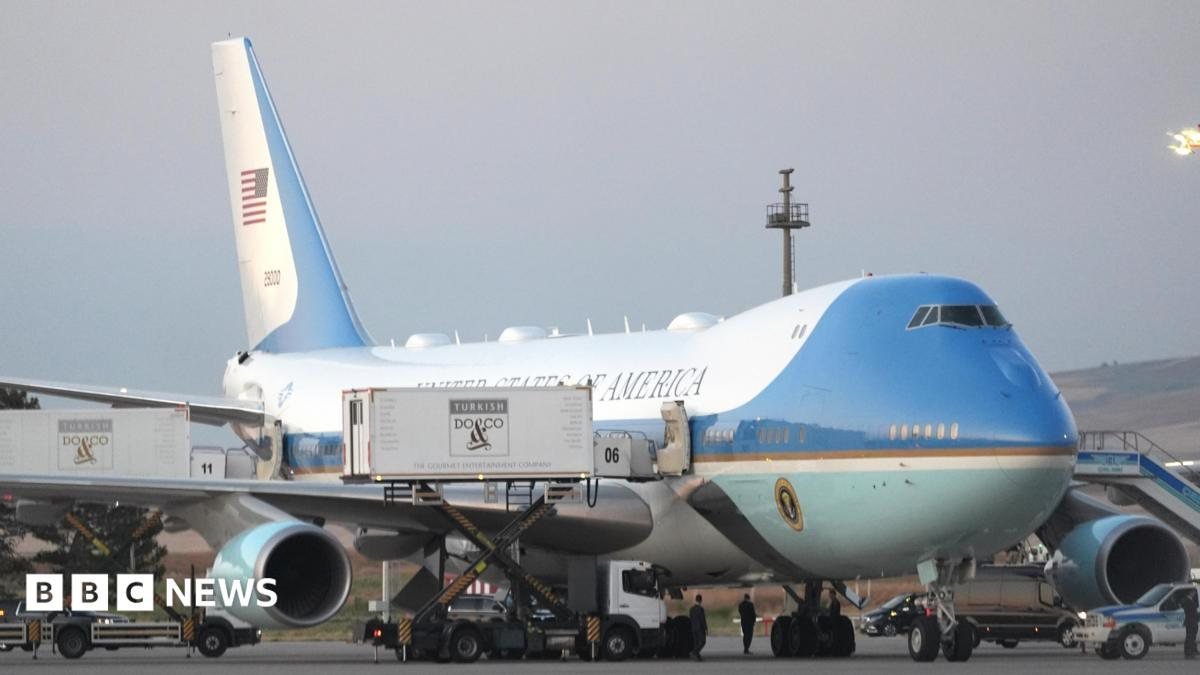
US President Donald Trump secretly switched aircraft during a trip to Turkey last month due to security concerns involving Iran, leaving two of his cabinet members and members of the press on a decoy plane, according to reports. Secretary of State Marco Rubio and Treasury Secretary Scott Bessent remained aboard the original aircraft, which maintained the "Air Force One" call sign to act as a decoy.
The incident occurred on July 8 following a NATO summit. After initially boarding the primary aircraft alongside Rubio, Bessent, and the White House press corps, Trump clandestinely exited the plane by hiding inside a catering truck. He was then transported to a military aircraft to fly out of Ankara.
While the designation "Air Force One" technically applies to any aircraft carrying the US president, the original plane retained the call signal during the flight to serve as a decoy. The second military aircraft carried Trump and Defence Secretary Pete Hegseth out of the Turkish capital.
Line of Succession and Key Officials on Board
According to CBS News, the BBC's US partner, Rubio and Bessent remained on the decoy aircraft to maintain the presidential line of succession in the event of an emergency. If a sitting president dies or becomes incapacitated, the Vice-President—currently JD Vance—takes power, followed by the Speaker of the House of Representatives and the President Pro Tempore of the Senate. The Secretary of State and the Treasury Secretary are next in the line of succession.
Other high-ranking officials who stayed on the decoy flight included White House Deputy Chief of Staff Stephen Miller and White House Communications Director Steven Cheung. Members of the traveling press pool were also aboard the decoy plane and later stated they were unaware they were flying on a decoy flight.
Speaking to reporters on Monday night, Trump confirmed the flight swap, stating that the decision was directed by the US military and the Secret Service. "They wanted me to go in a different flight," Trump said. He did not provide specific details regarding the nature of the security threat, noting only that he receives "a lot of threats" and adding that "any consequential president has a lot of threats."
Secret Service 'Shell Games' and Historical Precedents
It remains unclear what the cabinet secretaries, staff members, and Air Force personnel on board the decoy plane knew about the operation while it was underway. It is also unknown what level of danger, if any, the occupants of the decoy flight faced during the journey from Ankara.
Deceptive tactics, often referred to as "shell games" by Secret Service personnel, are a standard part of presidential security operations. These measures frequently include using identical heavily armoured limousines that switch positions within motorcades, as well as using multiple helicopters to transport the president.
Similar elaborate security operations have been employed during high-risk international travel in the past. In March 2000, then-President Bill Clinton traveled to Islamabad, Pakistan, using an unmarked executive jet that landed after a decoy aircraft painted in the traditional Air Force One livery.
Susan Page, a USA Today reporter who was serving as the head of the White House Correspondents' Association at the time, revealed this week that the White House had briefed her on those security arrangements beforehand. Page noted that she was informed of the extraordinary procedures due to the dangers of flying to Pakistan, adding that the risks threatened both the journalists and the president.
Press Association Seeks Future Protocols
During high-risk trips where decoy operations are used, reporters traveling with the president are typically briefed on the security measures and requested not to report on movements in real-time. However, members of the press pool on Trump's July 8 flight were not informed of the swap.
The White House Correspondents' Association has not issued a public statement on the Turkey incident. However, the association's president, Jacqui Heinrich, confirmed in an internal memo to the press corps that she had met with Trump administration officials regarding the matter.
Heinrich stated that she "advocated strongly for the importance of maintaining independent press coverage of the president and an accurate historical record of his movements." She has requested that the White House collaborate with the association to establish a formal protocol for handling extraordinary security situations in the future. The BBC has contacted the White House for comment on the matter.