
Top Board Games and Expert Strategies for Family Game Night

Establishing a regular family game night offers a reliable way to bring households together around the table, especially when everyone is tired of looking at screens. Based on years of weekly family play sessions, selecting the right mix of games and setting clear ground rules can significantly improve the experience for players of all ages.
Essential Tips for a Successful Game Night
To ensure a smooth and engaging evening, several practical strategies can be implemented before the first dice are rolled:
- Watch instructional videos: Rather than appointing someone to read a lengthy rulebook, which often leads to players tuning out, families can watch visual tutorials on YouTube to learn how to play.
- Prepare snacks in advance: Setting up food and drinks beforehand prevents mid-game interruptions and keeps players from getting hungry and frustrated.
- Pick a themed soundtrack: Some games, such as Mysterium, feature official companion soundtracks online. For others, playing a fitting playlist or gentle instrumental movie soundtracks helps set the mood.
- Ensure proper visibility: Playing around a large dining table allows everyone to sit comfortably in chairs and clearly see the board, which helps maintain interest.
- Banish mobile phones: Checking phones between rounds kills momentum and delays turns. Banning phones during play preserves the atmosphere.
- Set a hard time limit: To avoid exhausting marathon sessions, families should agree on a specific stop time before starting.
- Rotate game selection: Letting children take turns choosing the game prevents arguments. Alternatively, each family member can pick one game for the night.
- Balance familiar and new games: Introducing new titles alongside established favorites keeps game nights exciting.
- Opt for cooperative games: If sibling rivalries or highly competitive personalities cause tension, cooperative games where everyone works together can ensure a smoother evening.
Cooperative and Detective Games
When families prefer working as a team rather than competing against one another, several cooperative titles offer engaging challenges.
Boss Fighters QR: This fast-paced fantasy game for two to four players aged 10 and up combines a mobile app with a strategic deck-building card game. Players work together to battle ten boss monsters. By scanning cards during play, the monster reacts in real-time, requiring players to coordinate their heroes' unique abilities. A typical game lasts about 60 minutes.
Pandemic: Designed for two to four players aged 8 and up, this cooperative game tasks players with unique roles to eradicate four deadly diseases. Success relies on communication and group strategy, with games wrapping up in under 45 minutes.
MicroMacro: Crime City: This detective game works for one to four players aged 12 and up, though some cases touch on adult themes. Players use a magnifying glass to search a large city map for clues and suspects, solving mysteries through loose narratives. Cases take between 10 minutes to an hour, and a sequel, MicroMacro: Crime City—Full House, offers additional cases.
The Crew: Mission Deep Sea: A cooperative, trick-taking card game for two to five players aged 10 and up. It features underwater missions that gradually increase in difficulty. Players must complete specific tasks without discussing the cards in their hands, with rounds lasting about 20 minutes.
Strategic and Building Games
For players who enjoy resource management, spatial planning, and building empires, these strategic titles offer deep gameplay.
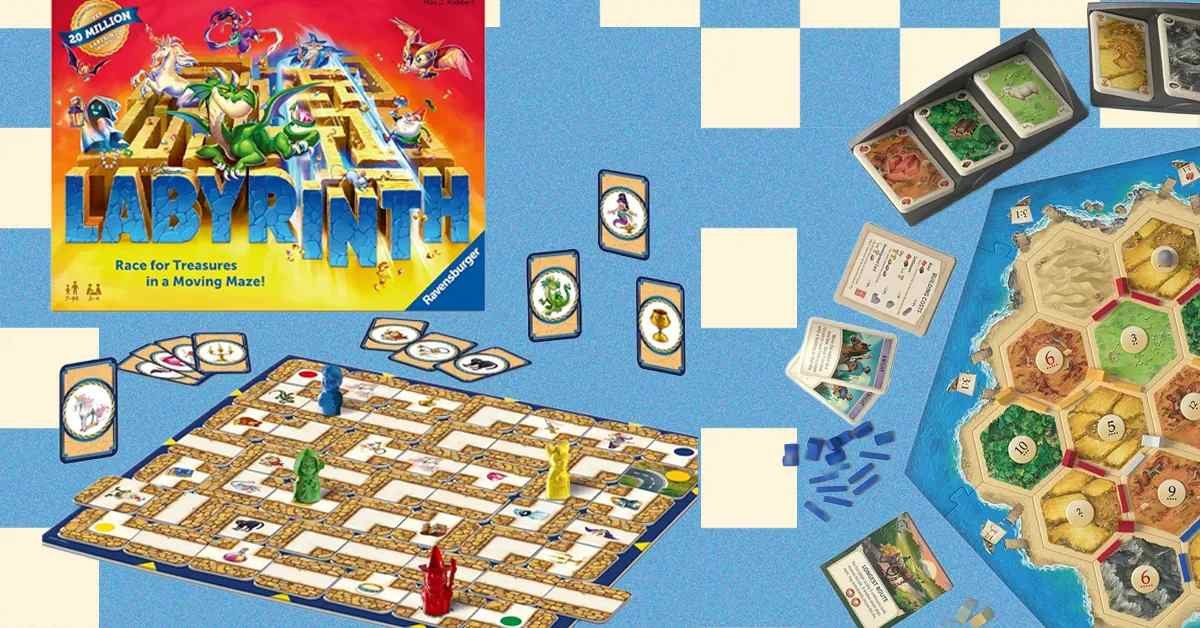
Catan: Formerly known as Settlers of Catan, this strategy game for three to four players aged 10 and up involves trading resources to build settlements on a board of hexagonal tiles. It features a robber mechanic that allows players to steal cards and block opponents. A junior version is available for younger children, and Catan: New Energies offers a fresh alternative. Playtime is approximately 60 minutes.
Labyrinth: Designed by a German psychologist, this simple game for two to four players aged 7 and up features a shifting maze. Players push tiles onto the board to alter pathways, aiming to collect treasures while blocking opponents. A game takes about 30 minutes.
Kingdomino: A quick game for two to four players aged 8 and up where players build a 5x5 kingdom using domino-like terrain tiles. Points are scored by matching terrain types and multiplying them by the number of crowns shown on the tiles. It plays in about 15 minutes.
Big Boss: Featuring a 1920s art deco style, this game for two to six players aged 10 and up focuses on founding companies, buying shares, and managing mergers. Players use numbered tiles and plastic building blocks to construct skyscrapers, with games lasting around 90 minutes.
Ticket to Ride: Published by Days of Wonder, this railway-themed game for two to five players aged 8 and up challenges players to claim train routes across the United States and Canada. A European version introduces ferries and tunnels, while Ticket to Ride: First Journey offers a simplified version for younger players. Playtime ranges from 30 to 60 minutes.
Quick-Play and Card Games
These titles offer faster setup times, simpler rules, or high-stakes card play for dynamic sessions.
Onitama: A two-player strategy game aged 10 and up that serves as good training for chess. Players use cards representing martial arts styles to move a master and four pawns, aiming to defeat the opposing master or occupy their temple. Games last 15 to 20 minutes.
Quacks of Quedlinburg: Set in medieval Germany, this push-your-luck game for two to four players aged 10 and up casts players as quack doctors brewing elixirs. Drawing too many "cherry bomb" tiles from a bag blows up the pot, ending the round. A full game consists of nine rounds and takes 40 to 60 minutes.
Codenames: A word-based party game for two to eight players aged 10 and up. Spymasters give one-word clues to help their teammates identify secret agents on a grid while avoiding enemy agents and an assassin. Rounds last about 15 minutes.
The Isle of Cats: A unique game for one to four players aged 8 and up where players rescue cats and arrange them onto a boat in a Tetris-like fashion. It features card drafting and resource management using fish, with a playtime of 60 to 90 minutes.
Port Royal: A card-drafting game for two to five players aged 8 and up set in the Caribbean. Players act as merchants amassing fortunes and recruiting crews, balancing risk by deciding when to stop drawing cards. Games take 20 to 50 minutes.
Exploding Kittens: A simple card game for two to five players aged 7 and up where players try to avoid drawing an exploding kitten card. It features humorous card art and special powers, playing in about 15 minutes.
The Chameleon: A bluffing game centered around a topic card containing 16 words. A dice roll determines the secret word, and one player, designated as the Chameleon, must try to blend in without knowing what the word is.