Silicon Valley Divided Over Proposed Restrictions on Chinese Open-Weight AI Models
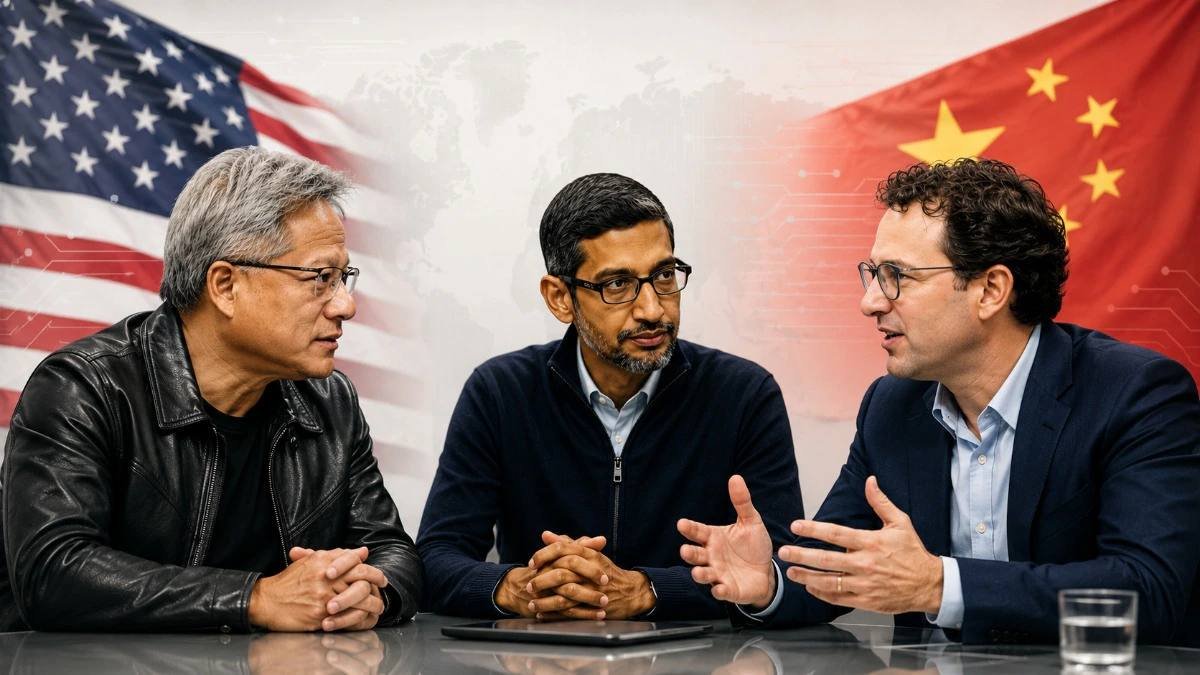
Silicon Valley is experiencing deep internal divisions over the rapid advancement of Chinese artificial intelligence models. For several years, American technology firms maintained a comfortable lead in the sector, operating under the assumption that Chinese competitors would not catch up quickly. However, this confidence is facing challenges as Chinese developers release a series of highly capable AI models, including DeepSeek, Zai's GLM 5.2, and Moonshot AI's open-weight model, Kimi K3.
These successive launches have divided the US tech industry. On one side, companies such as Anthropic are urging Washington to restrict Chinese AI models to protect American technological leadership and national security. Conversely, major players like Nvidia, Google, and Microsoft argue that the United States should not ban these models but should instead focus on developing superior technology.
The debate is intensified by the capabilities and accessibility of the Chinese models. Systems like Kimi K3 are not only more cost-effective but are also matching or exceeding the performance of leading American models, such as Anthropic's Claude and OpenAI's ChatGPT, in benchmark tests. Furthermore, many of these Chinese systems are open-weight models, allowing developers to download, customize, and run them on their own infrastructure. This provides an affordable alternative for startups and businesses that cannot afford expensive, token-based proprietary models from the US.
Anthropic Alleges Large-Scale Data Extraction
Anthropic has raised significant concerns regarding how Chinese firms have achieved these technological milestones. The developer of the Claude AI model alleges that China's rapid progress is the result of illicitly distilling American frontier models rather than independent research and innovation. According to Anthropic, Chinese firms have used the outputs of closed American models to train and improve their own competing systems.
Specifically, Anthropic claims to have identified industrial-scale campaigns conducted by three Chinese AI laboratories: DeepSeek, Moonshot, and MiniMax. The company alleges that these laboratories generated more than 16 million exchanges with Claude using approximately 24,000 fraudulent accounts. Anthropic states that these actions violated its terms of service and regional access restrictions to illicitly extract Claude's capabilities.
In response, Anthropic is calling on the US government to classify frontier AI model weights as critical national security assets. The company wants aggressive federal regulations placed on API access and legal penalties imposed on foreign firms found to have siphoned American AI data. Reports indicate that Anthropic and OpenAI have privately lobbied the Trump administration to implement stricter regulations on Chinese open-weight AI models, citing intellectual property theft and national security risks.
Industry Leaders Push Back Against Restrictions
The Trump administration has indicated that it is taking these concerns seriously. Treasury Secretary Scott Bessent stated that the administration is considering sanctions against Chinese companies found to have stolen American AI intellectual property, remarking that "open source is not open season on American IP." White House science adviser Michael Kratsios also condemned what he termed "large-scale, covert industrial distillation" of US AI technology. However, the claims that Moonshot AI's Kimi K3 was built using distilled data from Claude remain independently unverified.
Despite these concerns, a large portion of Silicon Valley opposes a ban on Chinese models. Many prominent industry figures argue that restricting access to competing models would harm American innovation. Nvidia CEO Jensen Huang has advocated for open access, stating that "the world needs both frontier closed models and frontier open models." Microsoft CEO Satya Nadella supported this view, describing open-weight AI as "essential to a healthy AI ecosystem."
Google CEO Sundar Pichai also noted that Google has long benefited from open source and supports the industry's latest open-weight AI initiatives. Mira Murati, the founder of Thinking Machine and former Chief Technology Officer of OpenAI, emphasized the collaborative nature of the technology, stating: "The knowledge that makes AI useful is diffused. It lives with scientists, engineers, clinicians, firms. For AI to benefit from distributed knowledge, it must itself be distributed."
Startups and the Search for a Middle Path
Other major entities, including Meta, IBM, Palantir, and Elon Musk, have also expressed support for open-weight models, arguing they foster innovation, reduce costs, and enable broader competition. Nearly 200 companies under the newly formed Little Tech Association wrote to the Trump administration urging it not to restrict Chinese open-weight AI. They highlighted that many American startups depend on these affordable open models and cannot easily transition to expensive proprietary alternatives.
Instead of a blanket ban, the association called for targeted safeguards against intellectual property theft while preserving global developer access to available AI models. Meanwhile, some proponents of open-weight models have faced accusations of inconsistency. Anthropic chief scientist Julian Schrittwieser questioned the sudden support for openness from historically proprietary companies, suggesting that if Nvidia and Microsoft truly champion open source, they should open-source CUDA and Windows.
OpenAI appears to be navigating a dual approach. While it joined other tech giants in signing an industry letter supporting open-weight AI, it has also reportedly lobbied the Trump administration behind closed doors to tighten restrictions specifically on Chinese open-weight models. Currently, the Trump administration is reportedly seeking a middle ground, focusing on targeted actions against specific companies accused of intellectual property theft or national security threats rather than implementing a broad ban.