Rajya Sabha MP Dr Vikramjit Singh Sahney Critiques AAP Governance and Outlines Punjab's Key Challenges

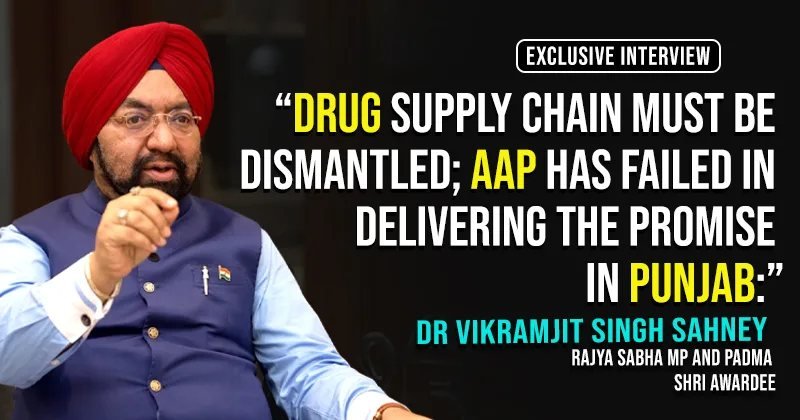
Rajya Sabha MP and Padma Shri Awardee Dr Vikramjit Singh Sahney has detailed his decision to leave the Aam Aadmi Party (AAP), pointing to a lack of internal consultation and a failure of governance in Punjab. Speaking in an interview with Organiser Assistant Editor Nishant Kumar Azad, Dr Sahney highlighted critical issues facing the state, including the drug menace, youth migration, and rising religious conversions.
Dr Sahney, who spent more than four years with AAP, explained that his decision to exit the party was driven by two primary factors. First, he noted his long-standing ideological and personal association with the Bharatiya Janata Party (BJP), which spans nearly twenty-five years. He explained that when AAP formed the government in Punjab, the party sought credible public figures outside its organizational cadre, leading to his nomination to the Rajya Sabha.
Lack of Consultation and Governance Priorities
Despite his position as a Member of Parliament, Dr Sahney stated that he was excluded from the party's political and parliamentary strategy discussions. He revealed that there was no established forum for MPs to discuss governance priorities with the party leadership. According to Dr Sahney, representatives were not regularly invited for consultations by either AAP national convener Arvind Kejriwal or Punjab Chief Minister Bhagwant Mann.
Furthermore, Dr Sahney expressed disappointment over the lack of support for development initiatives in the state. He stated that when MPs attempted to initiate development projects in Punjab, they received very little encouragement or handholding from the state government. After four years, he concluded that valuable time was being wasted without achieving meaningful outcomes for the region.
The Challenge of Youth Migration
Addressing the ongoing migration crisis, Dr Sahney pointed out that Punjab has experienced a significant culture of migration for decades. Reports indicate that approximately 1.5 to 2 lakh young people leave Punjab annually for countries such as Canada, Australia, and the United Kingdom. He attributed this trend to historical factors, including years of militancy, industrial stagnation, and a lack of economic diversification.
While Punjab was once India's most prosperous state in terms of per capita income, agriculture can no longer absorb the aspirations of the younger generation. Dr Sahney noted that countries like Canada actively encouraged immigration due to demographic needs, prompting families in Punjab to sell land to finance overseas education and migration. He lamented that the state has failed to create sufficient local opportunities to retain its talent, despite Punjabis achieving global success as entrepreneurs, professionals, doctors, and political leaders.
Addressing the Drug Menace and Supply Chains
Dr Sahney also criticized the AAP government's failure to fulfill its promise of making Punjab drug-free within one month of coming to power. He emphasized that the drug problem is highly complex, involving cross-border trafficking, organized supply chains, and local distribution networks. He argued that the state's delivery on this issue, as well as on agricultural commitments like the Minimum Support Price (MSP), has fallen short of expectations.
Through his organization, Dr Sahney operates twelve de-addiction and rehabilitation centres. He explained that effective rehabilitation requires a comprehensive approach, including counselling, yoga, meditation, sports, skill training, and sustained psychological support over several months. However, he stressed that rehabilitation alone cannot solve the crisis. He called for dismantling the drug supply chain, improving employment opportunities, and strengthening administrative coordination, noting that the scale of the drug trade suggests the involvement or failure of influential individuals and sections of the state machinery.
Concerns Over Religious Conversions
Another major concern raised by Dr Sahney is the rapid expansion of missionary activities and religious conversions in Punjab, particularly in the historically significant Sikh regions of Majha and Doaba. He attributed this phenomenon to social exclusion within the state, noting that sections of Scheduled Caste communities have often felt excluded or inadequately integrated into mainstream religious and social institutions.
According to Dr Sahney, missionary organizations recognized this social vacuum, actively visiting families facing hardship or illness to offer emotional and material support, thereby building trust. While acknowledging the contributions of the Shiromani Gurdwara Parbandhak Committee (SGPC) in managing historic gurdwaras and running institutions, he urged the SGPC leadership to allocate dedicated financial and organizational resources to address conversions, warning of long-term implications for Punjab's demographic balance and social cohesion.
BJP's Political Outlook in Punjab
Commenting on the political landscape ahead of the 2027 Assembly elections, Dr Sahney discussed the BJP's decision to contest the polls independently rather than forming an alliance with the Shiromani Akali Dal (SAD). He stated that alliance decisions remain the prerogative of the party high command but highlighted the significant organizational momentum the BJP has gained in Punjab in recent months.
Dr Sahney pointed to key events that have energized the party cadre, including Union Home Minister Amit Shah's rally in Moga in March 2026, party President Nitin Nabin's organizational meetings, and Prime Minister Narendra Modi's rally in Jalandhar. He concluded that the growing acceptance of the party and the strengthening of its organization at all levels will have a major impact on the upcoming 2027 elections.