Protesters Resist Evacuation at Jantar Mantar After Sonam Wangchuk’s Removal from Hunger Strike

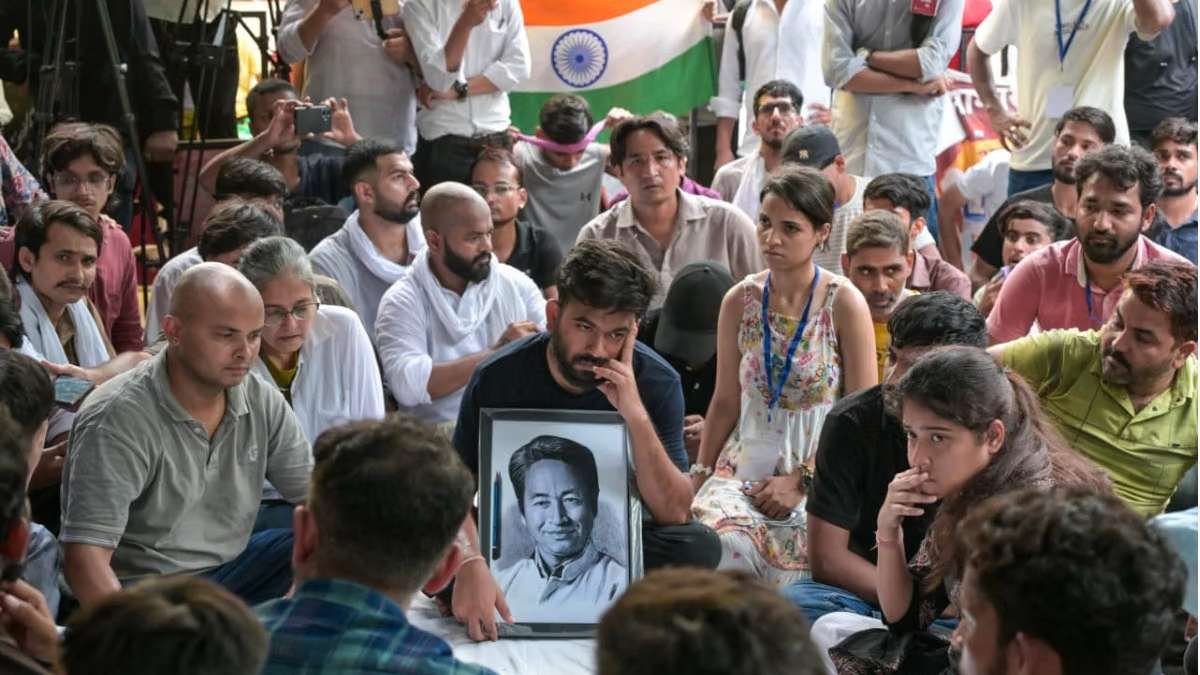
Anger and resentment mounted among protesters at Jantar Mantar in New Delhi on Saturday after activist Sonam Wangchuk, who had been on a hunger strike for 20 days, was removed from the protest site and taken to Safdarjung Hospital. Despite repeated requests from security personnel to vacate the area, nearly 1,000 protesters remained at the site, vowing to intensify their agitation.
Security personnel, including the Delhi Police, the Rapid Action Force (RAF), and the Central Reserve Police Force (CRPF), arrived at the protest site around 7:00 AM. Amid allegations of a forceful evacuation, police dispersed the crowd and took Wangchuk away. Some protesters clashed with the security forces as repeated announcements were made instructing them to leave the premises.
The Delhi Police issued a statement clarifying that the action was taken in accordance with directions from the Delhi High Court and on the advice of medical experts, citing Wangchuk’s deteriorating health condition.
Protesters Resolute Despite Police Action
The removal of Wangchuk has drawn sharp criticism from supporters who view the government's action as an attempt to suppress their movement. Ankur Saxena, a consultant with a private firm who was present at the site, described the development as a turning point for the demonstration.
"Today is the tipping point. This action by the government has made us more resolute," Saxena said. "If Sonam Wangchuk, who is such an influential figure, can be suppressed and silenced, then where do we stand? This action has brought us even more together. This movement will not die down."
Birjender, a 37-year-old consultant with a multinational corporation, expressed similar frustration, calling the government's response an abuse of power. He suggested that the intervention had only served to energise individuals who were previously passive bystanders.
"The government has shot itself in the foot. It has riled up even those who were not active protesters," Birjender said. "Since the number of protesters was not in the thousands, the government probably thought it could crush the movement. Instead, it has energised even those who had no plans to come to Jantar Mantar."
For 79-year-old S.P. Singh, the core issues of the protest remain unchanged regardless of who is leading the demonstration. Observing Cockroach Janta Party (CJP) founder Abhijit Dipke addressing supporters, Singh noted that police action might deter some individuals but would not erase demands for accountability.
Concerns Over Medical Transparency
Outside Safdarjung Hospital, Wangchuk’s wife, Gitanjali Angmo, raised concerns regarding the medical assessments provided by the hospital administration. She stated that doctors informed her that Wangchuk’s potassium level had dropped to 2.9, a significant decrease from the 4.3 level reported on Friday evening.
Angmo accused the hospital of a lack of transparency, stating that officials showed her a medical report but refused to share a copy with the family. She requested the hospital administration to discharge Wangchuk so they could admit him to a medical facility of their own choosing.
Back at Jantar Mantar, RAF personnel dismantled banners from the makeshift stage and ordered volunteers to leave. In response, supporters formed a human chain around Abhijit Dipke, who declared that the demonstration would proceed despite the clearance operations.
Political Leaders Condemn Government Intervention
Several political figures joined the demonstration to express solidarity with the protesters. Communist Party of India (Marxist) leader Brinda Karat linked the timing of Wangchuk’s removal to the recent appointment of a new Delhi Police Commissioner.
"Yesterday you suddenly replaced the Delhi Police Commissioner and appointed a new officer, and today you launch this action," Karat said. She argued that the intervention was timed to prevent an embarrassing situation for the government ahead of a major march planned for July 20, which would mark one month of the protest.
Samajwadi Party Lok Sabha MP Pushpendra Saroj also criticised the deployment of force, attributing the action to the growing political traction of the movement. In recent days, political figures including former Delhi Chief Minister Arvind Kejriwal, Samajwadi Party MP Dimple Yadav, and Congress leader Pawan Khera had visited Wangchuk at the protest site.
Saroj stated that while political allies had advised Wangchuk to end his hunger strike and transition to a broader campaign, the activist had insisted on continuing his fast until July 20. Saroj warned that the government's use of force would likely lead to a larger mass mobilisation on the planned protest date.