
Projection Mapping Show Transforms Mumbai's Afghan Church

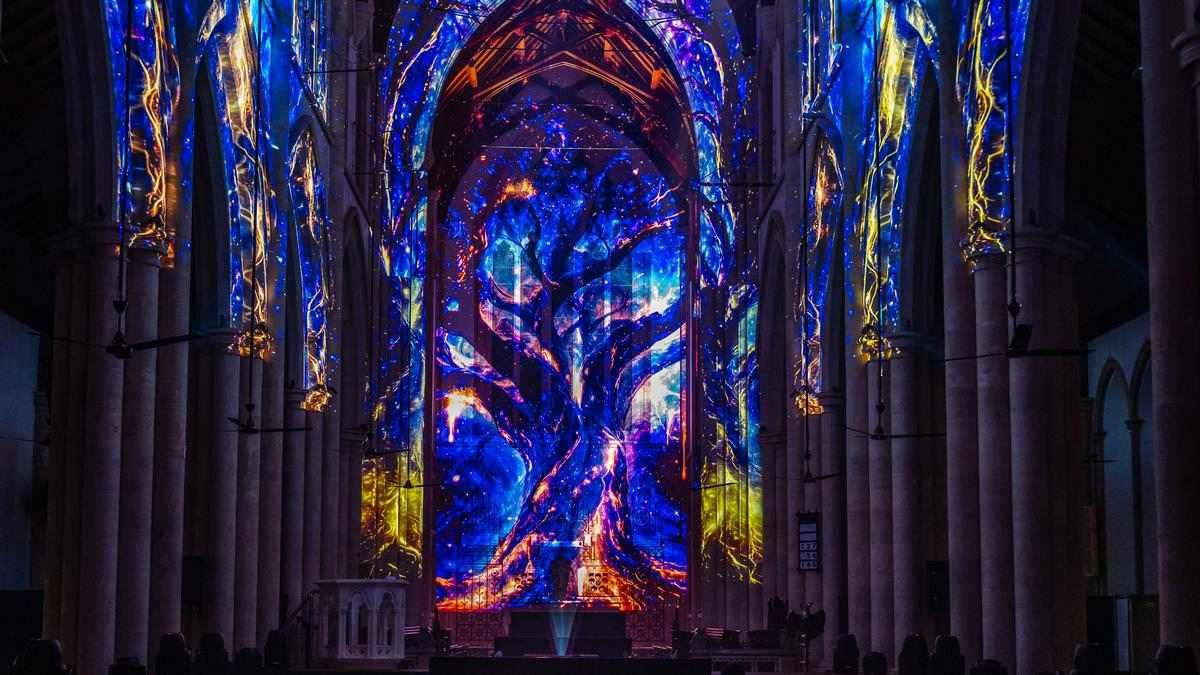
Inspired by light-and-sound spectacles in the West, a projection-mapping show at Mumbai's Afghan Church sought to transform how residents experience the city's historic landmarks.
Published on September 1, 2026, the show, titled Ascension, was presented inside the church as part of the Mumbai Light Festival from August 27 to 29. It was the first projection mapping project inside a Grade I heritage structure in Mumbai by Floating Canvas Company (FCC).
Projection Mapping Installation
The show transformed the Afghan Church into a canvas for stars, clouds, and lights, with projections receding into the church's depths and tracing the lines of an arch or climbing towards the ceiling. The effect was most striking when the projection worked with the architecture rather than overpowering it.
According to Rahul Singh Yadav, creative director at FCC, the theme, motifs, and animation were carefully developed to ensure they complemented the architecture without altering its character. The animation was designed to flow gently through the details, allowing the space to remain the anchor.
Creating that effect required more than just pointing the projectors at the walls. FCC first surveyed the church to create multiple digital masks to map the artwork onto its uneven surfaces. Between 15 to 20 high-resolution, high-lumen projectors were required for a space of this scale, while installation and calibration took three days.
Challenges and Solutions
Working with the stained glass came with its own challenges as glass typically lets light pass through rather than reflecting it back. However, FCC leveraged the colour, texture, and thickness of the iconic stained glasses to integrate them seamlessly into the overall experience.
The show itself followed a simple idea: a journey from Earth towards the cosmos. Clouds, stars, and drifting light gradually filled the interior, suggesting movement beyond the physical boundaries of the church. The experience invited the viewer to question where the journey truly takes place.
What added to the immersive aspect was that the audience was standing inside the architecture rather than watching a projection on a facade. FCC has previously worked on the exteriors of several Mumbai heritage structures. Indoors, the viewer is relatively stationary, allowing the projections to unfold around them.
Projection Mapping in Heritage Buildings
Projection mapping, inside heritage buildings, is hardly a new phenomenon. Mumbai is catching up to something cities abroad have been doing for years. AURA launched inside Paris's Notre-Dame in 2017 uses dozens of projectors and lights to turn the basilica's interior into an immersive light show.
For the Afghan Church project, FCC follows the company's earlier work at the David Sassoon Library, and later interventions at the CSMVS Museum and Rajabai Clock Tower. The larger ambition, Rahul says, is to make residents relate to buildings they walk past without a second glance.