Parliament Passes Public Examinations Amendment Bill as Opposition Walks Out of Rajya Sabha

Parliament has passed the Public Examinations (Prevention of Unfair Means) Amendment Bill, 2026, after the Rajya Sabha cleared the legislation on Thursday. The passage in the Upper House follows the Lok Sabha's approval of the Bill on Wednesday.
The final passage of the bill occurred amid a walkout by Opposition members belonging to the Indian National Developmental Inclusive Alliance (INDIA). The Opposition walked out of the House before the reply by Minister of State for Personnel, Public Grievances and Pensions Jitendra Singh, who addressed the chamber following a seven-hour debate. The Rajya Sabha had taken up the Bill after the government listed it as a supplementary agenda.
Government Defends Reforms and Educational Policy
Replying to the debate, Minister of State Jitendra Singh defended the government's record and questioned the Opposition's claims regarding examination irregularities. He specifically challenged the Opposition's contention that 152 examination paper leaks had occurred under the government led by Prime Minister Narendra Modi, stating that they could not authenticate the figure.
Mr. Singh highlighted the government's efforts to reform medical education, stating that measures had been taken to free the sector from the malice of the management quota. He noted that the government has increased the number of All India Institutes of Medical Sciences (AIIMS) alongside expanding both undergraduate and post-graduate seats in medical education.
According to the Minister, the government's approach focuses on the democratisation of education. He added that the National Education Policy has liberated children from the slavery of subjects chosen by their parents, teachers, or guardians.
Objectives of the Legislation
While moving the Bill, Mr. Singh stated that the legislation reflects the Union government's commitment to safeguarding the interests of students and youth. He said the measure is designed to ensure merit, consistency, transparency, and credibility within the public examination system.
Mr. Singh explained that the objective of the legislation is to establish greater consistency, credibility, and transparency in public examinations. This, he said, would ensure that sincere and deserving candidates are rewarded for their genuine efforts, preventing their futures from being jeopardised by organised examination-related crimes.
Opposition Demands Inquiry and Resignations
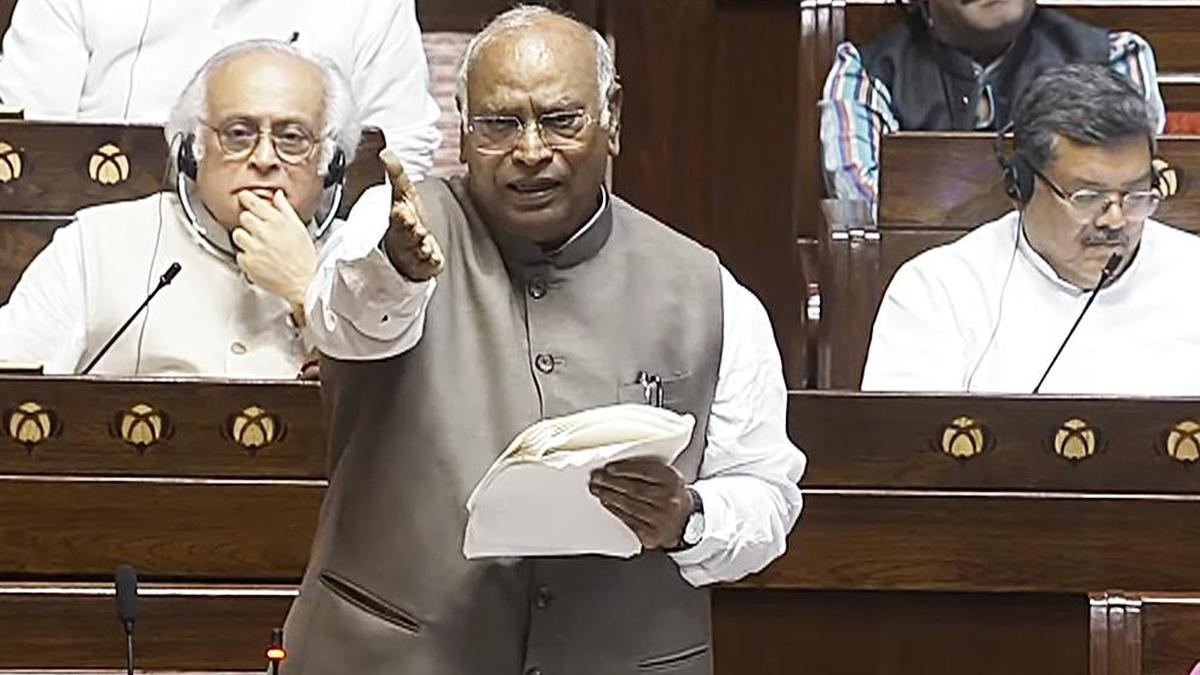
Initiating the debate, Leader of the Opposition in the Rajya Sabha Mallikarjun Kharge demanded a high-powered committee monitored by the Supreme Court to probe the NEET paper leaks and the subsequent police action against protesters. He also demanded the resignation of Union Home Minister Amit Shah, warning that people's power would make him answerable for the government's actions against students.
Mr. Kharge criticised the Home Minister for remaining silent during the unrest, stating that in the interest of the nation, he should have spoken openly. He further criticised the timing and substance of the Bill, calling it much delayed and arguing that it fails to address how to prevent paper leaks.
According to Mr. Kharge, question papers for 152 State and Central examinations were leaked over the last 10 years, with no one being punished for the crimes. He noted that following pressure from nationwide youth protests, the Education Minister had resigned for the first time in 12 years, the Higher Education Secretary was transferred, and the government claimed to have removed 47 officials of the National Testing Agency (NTA).
Debate Over Vacancies and Systemic Issues
Mr. Kharge also raised concerns regarding employment, stating that more than 30 lakh posts are currently lying vacant across the country. He alleged that the Centre does not want to fill these vacancies because a majority of the posts would have gone to Dalits, Adivasis, and Backward Classes.
Other Opposition members raised further concerns during the debate. Congress MP Mukul Wasnik highlighted systemic issues in the conduct of examinations and urged the government to address the matter seriously. Sagarika Ghose of the Trinamool Congress also demanded the Home Minister's resignation, calling on him to make a statement, answer the students, and apologise.
Rashtriya Janata Dal MP Manoj Jha and Samajwadi Party MP Ramgopal Yadav demanded that the NTA be dismantled. Communist Party of India (Marxist) member John Brittas argued that the government was failing to treat the root cause of the issue, which he identified as the commercialisation of education. While the DMK did not join the India bloc walkout, the party moved amendments against the Bill, which were subsequently defeated.