Nihang Sikhs and the Living History of the Warrior Tradition

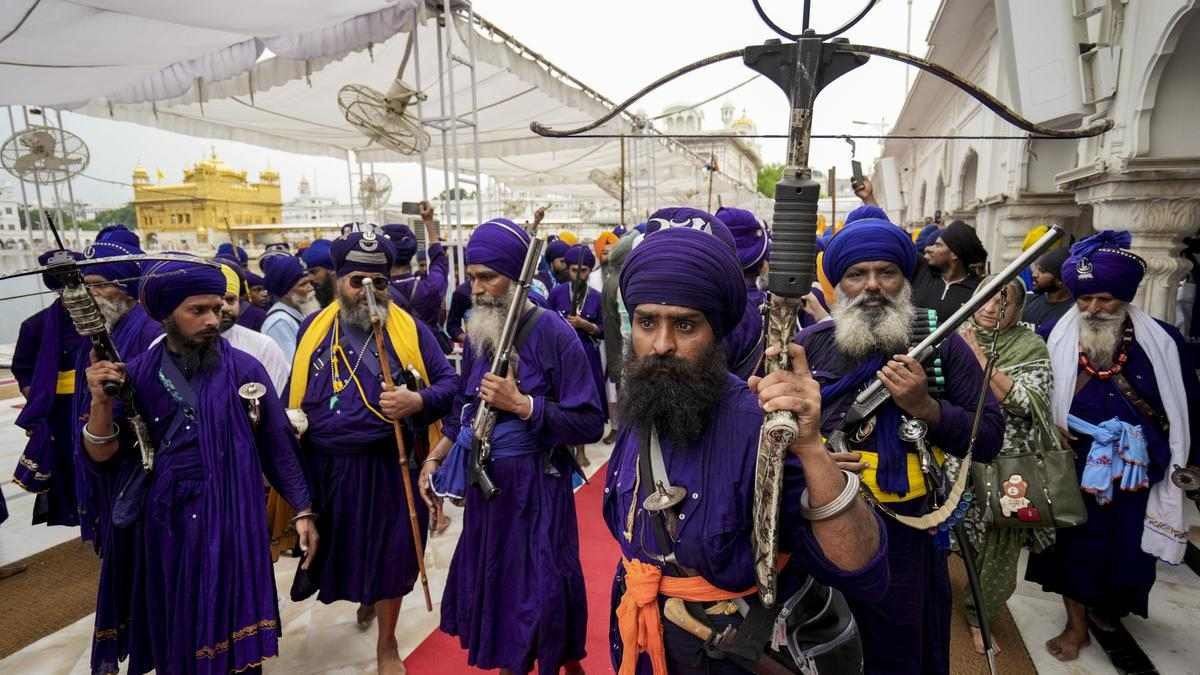
The distinctive appearance of Nihang Sikhs has long made them a prominent presence in public gatherings. Dressed in electric-blue robes, wearing towering conical turbans woven with steel quoits, insignia, and rosaries, they carry swords, spears, and other traditional weapons. While their attire is highly visual, for the Nihangs, these elements are far from ornamental. Instead, they represent a living connection to a centuries-old religious and martial heritage.
The community has recently returned to public attention following an attack on Shiromani Akali Dal president and former Punjab Deputy Chief Minister Sukhbir Singh Badal. The incident occurred on August 13 at the Mata Sahib Devan Ji Gurdwara in Nanded, Maharashtra. Badal suffered a hand injury that required surgery after being attacked with a kirpan. The accused, identified as 62-year-old Jaspal Singh, had been serving at the gurdwara for two years and was described as a Nihang. An investigation into the attack remains underway.
Recent Public Presence and Historical Origins
Beyond the recent incident in Nanded, Nihangs have been visible at major public demonstrations in recent years. They maintained a conspicuous presence during the farmers' agitation at Delhi’s Singhu border in 2020-21, and more recently, they were seen at the student protests at Delhi’s Jantar Mantar in July 2026.
The origins of the Nihangs are closely tied to the creation of the Khalsa Panth by the tenth Sikh Guru, Gobind Singh, in 1699. Traditionally regarded as "Guru ki fauj," or the Guru’s army, they embody the armed warrior tradition within Sikhism. The name "Nihang" is commonly associated with fearlessness and freedom from worldly attachment. Another historical interpretation traces the term to the Persian word "nahang," meaning crocodile, which invokes the creature's ferocity and toughness.
The tradition developed during an era when Sikh communities faced severe military persecution. Nihang warriors formed mobile fighting groups to defend Sikh settlements and religious institutions against Mughal forces and, later, Afghan invaders. This martial tradition was subsequently integrated into the military structures of the Sikh misls and the forces of Maharaja Ranjit Singh.
Transition to Custodians of Heritage
With the end of historical warfare, the battlefield role of the Nihangs gradually receded, but their rigorous discipline survived. Training in weapons, horsemanship, and physical endurance, alongside their distinctive dress and rituals, became a means of preserving the military heritage of the Khalsa. Today, Nihangs do not function as a standing army; instead, they serve as custodians and practitioners of their religious and martial traditions.
There is no single, centralised organisation that represents the entire Nihang community. Historically, they were divided into two broad dals: the Baba Budha Dal, associated with older bands, and the Taruna Dal, associated with younger bands. Over time, both have split into numerous factions. Researchers estimate that there are currently more than 30 Nihang factions, both large and small, operating in Punjab. Because of their mobile and decentralised nature, there is no central command or membership registry, meaning one group does not necessarily speak for another.
The Tradition of Mobility and Martial Displays
Mobility remains a core aspect of the Nihang lifestyle. Travelling bands, known as chalda vaheer, move with their horses and jathas along an annual religious circuit that connects major Sikh historical centres. This cycle prominently features locations such as Muktsar, Anandpur Sahib, Talwandi Sabo, Baba Bakala, Amritsar, and Hazur Sahib in Nanded. According to Sikh historian Dr. Balwant Singh Dhillon, this movement is not merely travel, but a practice that keeps alive their relationship with historical Sikh sites while allowing them to gather, worship, and train.
This martial identity is displayed most prominently during the festival of Hola Mohalla at Anandpur Sahib, the birthplace of the Khalsa. During the festival, Nihangs gather in large numbers to ride horses and demonstrate Gatka, the traditional Sikh martial art, alongside mounted manoeuvres and mock battles. These demonstrations are intended to keep alive the "sant-sipahi" (saint-soldier) ideal, which balances spiritual devotion with readiness for physical defense.
The Code of Bani and Bana
Historians and scholars caution against identifying a Nihang solely by outward appearance. Varinder Walia, a former Punjabi daily editor and professor at Punjabi University in Patiala, explained that the traditional order demands both "bani" (wisdom) and "bana" (attire). A genuine Nihang is expected to observe daily prayers, meditation, knowledge of Sikh scripture, and the Khalsa code, alongside physical disciplines like Shastar Vidya (the study of traditional weaponry), horse-riding, and seva (selfless service).
Nihang life does not strictly require the renunciation of family or livelihood. While some members live highly disciplined religious lives within their dals, others marry, work, and maintain families while fulfilling their obligations to their respective jathas. Their institutions are sustained through devotee offerings and the management of religious and agricultural resources, with some groups maintaining gurdwaras, camps (deras), and educational institutions.
The city of Nanded holds a significant place in this tradition. Located on the Godavari River, it is home to Takht Sachkhand Sri Hazur Sahib, one of Sikhism's five Takhts. It was here that Guru Gobind Singh spent his final days, ended the line of human Gurus, and declared the Guru Granth Sahib as the eternal Guru. The presence of Nihang-managed gurdwaras in this region reflects a long-standing institutional connection, even as the recent incident has brought the community under renewed public scrutiny.