
NASA Launches Nancy Grace Roman Space Telescope to Map Universe and Study Dark Energy

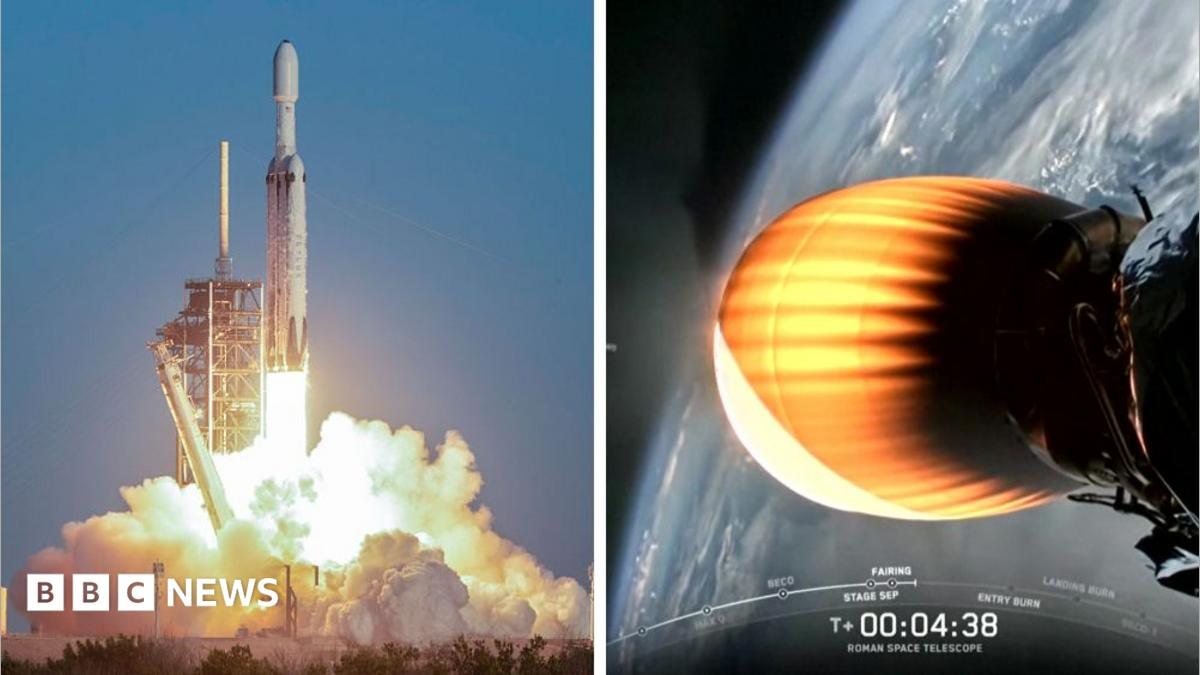
The US space agency NASA has successfully launched its powerful next-generation space telescope from the Kennedy Space Center in Florida. The Nancy Grace Roman telescope blasted off on Sunday morning local time, embarking on a multi-year mission to explore dark energy, dark matter, black holes, and other mysteries of the cosmos.
The telescope began its journey aboard a SpaceX rocket. Approximately 30 minutes after liftoff, the spacecraft successfully separated from the rocket and began its 100-day journey to its designated orbiting point. This vantage point is located roughly one million miles away from Earth.
Following the launch, Jackie Townsend, a project manager for the Roman telescope, expressed satisfaction with the start of the mission during a news conference. Townsend described the launch as "glorious" and noted that the ride was magnificent, placing the spacecraft exactly where the team wanted it to be.
A Vastly Expanded Field of Vision
According to NASA, the Nancy Grace Roman telescope is designed to capture vast panoramic views of space. Its field of vision is 100 times larger than that of both the Hubble Space Telescope and the James Webb Space Telescope. This expansive view will allow scientists to conduct sweeping surveys of the cosmos.
Astronomer Jenifer Millard explained that the telescope will operate at a distance four times further from Earth than the Moon. This positioning is crucial for its highly sensitive infrared cameras, which detect what Millard describes as "heat light." By positioning the telescope one million miles away, NASA ensures that infrared light emitted by the Earth and the Moon does not interfere with the observations.
While the James Webb Space Telescope, launched in 2021, also orbits the Sun at a similar distance of one million miles, it does not possess the same wide field of vision. Meanwhile, the older Hubble Space Telescope, launched in 1990, operates much closer to home, orbiting approximately 300 miles above the surface of the Earth.
The Search for New Worlds
One of the primary objectives of the Roman telescope is to chart planets outside our solar system, known as exoplanets. Nicky Fox, a NASA administrator, stated that the telescope is poised to change how humanity views the Universe. Fox anticipated that the mission could discover tens of thousands, or potentially up to 100,000, new exoplanets.
Fox emphasized that searching for these distant worlds is central to answering one of NASA's core questions: whether humanity is alone in the universe. The advanced capabilities of the Roman telescope will allow scientists to resolve the atmospheres around these distant planets to determine if they could potentially support life.
The significance of the launch drew attention from US President Donald Trump, who called into the space agency's post-launch news conference. Trump congratulated the scientists and engineers working on the project, praising their achievements in space exploration.
Mapping Dark Matter and Dark Energy
Beyond finding exoplanets within our own galaxy and beyond, the telescope is tasked with investigating the fundamental forces shaping the universe. Scientists plan to use the telescope's data to create detailed, multi-layered cosmic maps of the universe at various stages of its history.
Millard compared these projected maps to an onion, where researchers can peel back layer after layer to observe how the distribution of galaxies has changed over cosmic time. This distribution will help scientists study dark matter and dark energy, which are believed to make up about 95% of the universe.
While dark matter acts as an invisible gravitational glue holding galaxies together, dark energy is a repulsive force driving the accelerating expansion of the universe. Although scientists can observe the effects of these phenomena, their exact nature remains a mystery that the Roman telescope aims to help solve.
The Legacy of Nancy Grace Roman
The telescope is named in honor of physicist Nancy Grace Roman, who served as NASA's first chief astronomer in the 1960s and was the agency's first female executive. During her tenure, she played a key role in securing approval from the US Congress for the Hubble Space Telescope. Roman later remarked that Hubble's most interesting discovery was dark energy.
The new telescope carrying her name has a primary mission lifespan of five years, though NASA has set a goal to operate it for up to 10 years. Over its operational lifetime, the telescope's surveys are expected to help map billions of galaxies, study black holes, and explore objects ranging from our own solar system to the edge of the observable universe.