Karnataka CM D.K. Shivakumar Outlines AI Education Plans and USD 3 Trillion Economy Goal

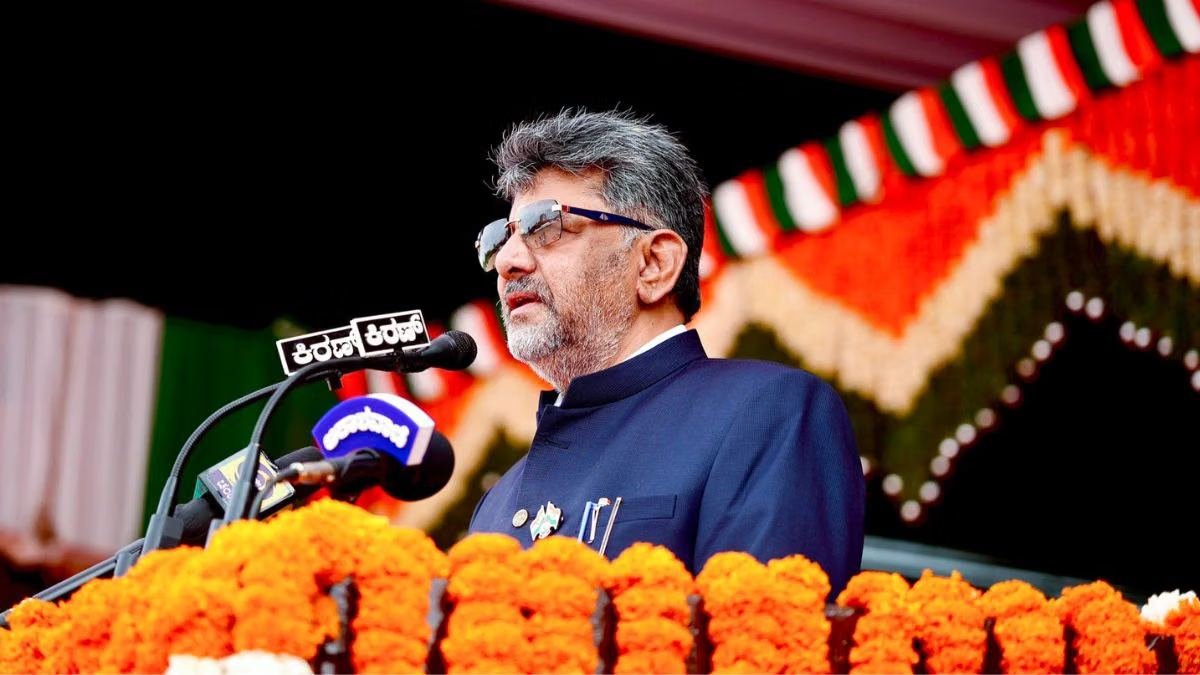
Karnataka Chief Minister D.K. Shivakumar has proposed the introduction of artificial intelligence (AI) education in schools across the state from Class 6 onwards. Delivering his maiden Independence Day speech in Bengaluru, the Chief Minister emphasized that the modern era requires a stronger focus on AI, outlining several technological, educational, and economic initiatives aimed at transforming the state.
During his address, Shivakumar announced a long-term economic target to elevate Karnataka’s Gross State Domestic Product (GSDP) from its current level of Rs 32.81 lakh crore to a USD 3 trillion economy (equivalent to Rs 320 lakh crore) by the year 2047. To support this growth, the state government plans to implement extensive reforms in public education, industrial development, and urban infrastructure.
Statewide AI Education and School Upgrades
The state government’s new educational roadmap focuses heavily on digital literacy and coding skills for young students. Shivakumar announced two primary initiatives to drive this transition: “AI Akshara Abhiyana” and “Coding Gurukul.” According to the Chief Minister, the Coding Gurukul initiative will offer students early opportunities to learn AI and develop coding capabilities.
In addition to school-level programs, Karnataka has proposed establishing India’s first public AI university in Bengaluru. The government plans to commence AI Certificate Courses by January 2027 and set up dedicated AI Hubs across the state to position Bengaluru as the country’s “AI capital.”
To upgrade general school infrastructure, the government intends to develop 1,000 government schools into “Karnataka Public Schools” over the next two years. These institutions will provide bilingual education, digital classrooms, modern infrastructure, vocational training, and student transportation under a single roof from LKG to Class XII, benefiting an estimated 10 lakh students.
Addressing Regional Imbalance and Industrial Growth
Acknowledging the historical concentration of development in southern districts like Bengaluru, the Chief Minister highlighted measures to address regional imbalances. These steps are based on the recommendations of the Prof Govind Rao Committee, which conducted a comprehensive study of 236 taluks in the state.
As part of these measures, the government plans to establish five Global Technology Centres in Kalaburagi, Belagavi, Hubballi-Dharwad, Mangaluru, and Mysuru. The state has established a transparent mechanism to utilize Rs 4,291 crore during the 2026–27 financial year for this purpose.
To encourage industrial growth in less developed areas, a special incentive package is being prepared for backward taluks. The government will offer a monthly incentive of Rs 2,500 per job created by entrepreneurs in the state’s 10 most backward districts. This incentive will remain active for two years and is projected to generate approximately one lakh new jobs.
Employment Initiatives and Bengaluru Infrastructure
The state government also plans to fill approximately 72,000 vacant government positions across various departments. To assist youth seeking private sector employment, the government will launch “Yuva Udyoga Setu,” a digital platform designed to connect job seekers, employers, and educational institutions.
Furthermore, 100 Government Industrial Training Institutes (ITIs) will be converted into employment-oriented campuses. This initiative, run in partnership with private industries, aims to secure employment opportunities for 10,000 young individuals. Near Kempegowda International Airport in Doddaballapura, an Advanced Manufacturing Cluster is set to be established with Rs 20,000 crore in secured investments, which is expected to create nearly one lakh jobs.
For Bengaluru, the government has initiated infrastructure projects worth Rs 1.5 lakh crore. This includes Rs 5,000 crore allocated for major road developments. The long-delayed Peripheral Ring Road project has been rebranded as the Bengaluru 45 Business Corridor (BBC), which involves constructing a 117-kilometer ring road at an estimated cost of Rs 26,000 crore.
Administrative Reforms and Public Services
To improve law and order administration, the Bengaluru Police Commissionerate will be reorganized into five separate commissionerates. This administrative restructuring follows a similar model to the division of the Greater Bengaluru Authority (GBA) into five smaller corporations.
Additionally, the state government plans to establish a new vehicle insurance corporation. This entity is intended to provide affordable and reliable vehicle insurance services directly to the residents of Karnataka.