
Hindu Munnani Criticises TVK Government's Maiden Budget Over Jerusalem Subsidy and Quaide Milleth Award

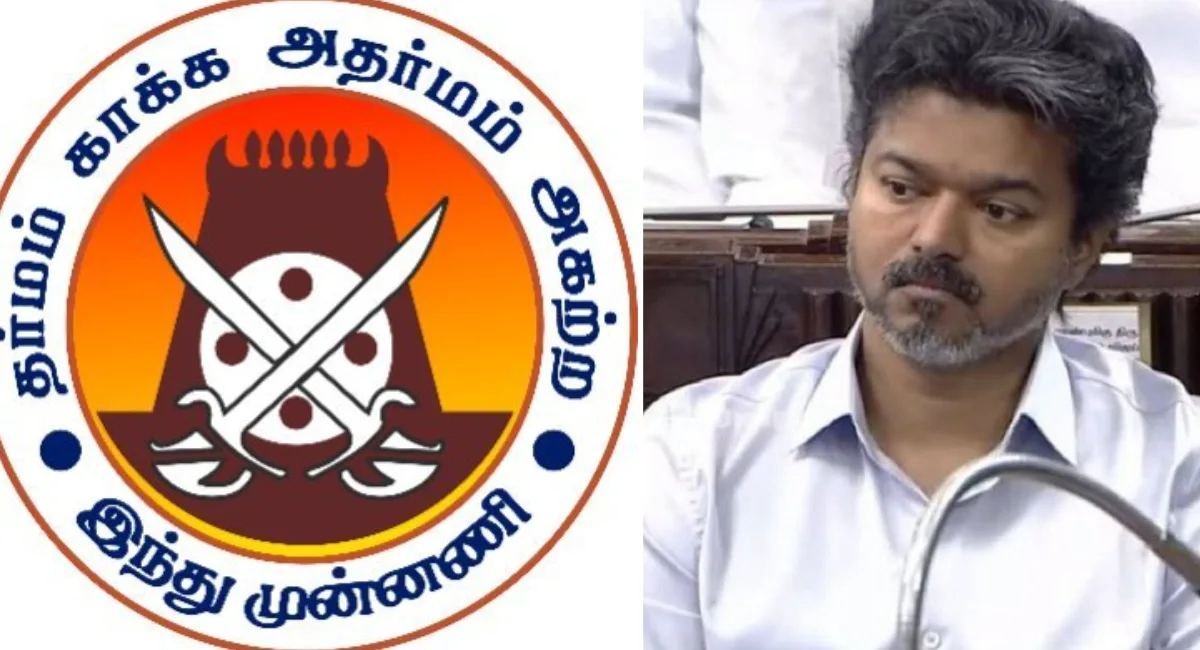
The Tamil Nadu government's maiden budget, presented on August 5 by Finance Minister N. Marie Wilson, has drawn sharp criticism from the Hindu Munnani and other Hindu organisations. While the budget received positive feedback from members of the public and various political parties, critics argue that several proposals show a tilt toward minority communities rather than maintaining secular standards.
The primary points of contention raised by the Hindu Munnani include a newly announced state award named after Quaid-e-Millat (Muhammad Ismail) and an increase in the state subsidy for Christian pilgrims travelling to Jerusalem.
Objections to the Quaid-e-Millat Award on Thiruvalluvar Day
The Tamil Nadu government announced the creation of a new state award in honour of the prominent leader Quaid-e-Millat (M. Muhammad Ismail Rowther), which is scheduled to be presented annually on Thiruvalluvar Day on January 15.
Hindu Munnani State President Kadeswara C. Subrmaniam stated that while the budget proposals as a whole could be welcomed, specific announcements reveal an intention to appease minority communities. He remarked that presenting an award named after Quaide Milleth on Thiruvalluvar Day amounts to humiliating the saint-poet Thiruvalluvar, urging Chief Minister C. Joseph Vijay to reconsider the decision. Subrmaniam compared the combination of the award and the day to mixing sweet Pongal with spicy Vadakari, stating the two do not go together.
Subrmaniam highlighted that Quaid-e-Millat, who served as the Madras Presidency Muslim League president during Partition, supported the division of the country alongside Mohammed Ali Jinnah. Although he chose to remain in independent India and founded the Indian Union Muslim League (IUML) to work for the civil rights of Muslims, the Hindu Munnani leader argued that honoring a political figure from the pre-1947 Muslim League—which shared responsibility for the two-nation theory—with a state-sponsored award is unacceptable. He urged the government to recall the announcement and name the award after a Tamil scholar instead.
Controversy Over Jerusalem Pilgrimage Subsidy
Another major point of criticism is the government's decision to increase the financial subsidy for individuals undertaking the pilgrimage to Jerusalem from Rs. 25,000 to Rs. 35,000. Hindu Munnani and various social media users questioned the TVK government's fiscal priorities, pointing out what they describe as double standards.
Critics questioned why the state government continues to increase temple entry fees and other charges for Hindu devotees while simultaneously using taxpayer funds to subsidise religious pilgrimages to foreign countries. They argued that while churches and mosques do not contribute revenue to the state, the government generates substantial income from Hindu temples managed by the Hindu Religious and Charitable Endowments (HR&CE) Department, which they allege suffers from poor maintenance and a lack of infrastructural spending.
Allegations of Appeasement and Administrative Bias
Further controversy arose during the presentation of the budget. Observers noted that Finance Minister N. Marie Wilson arrived in the Assembly carrying a rosary bead mala and offered a Christian prayer before commencing the budget reading.
Critics have pointed out that several key positions within the administration are held by Christians, including Chief Minister Joseph Vijay, Adhav Aruna, Finance Minister Marie Wilson, and advisers John Arockiasamy and CoP Amal Raj. Opponents allege that these appointments and policies, such as the Jerusalem subsidy, represent a continuation of minority appeasement strategies.
Additionally, the Hindu Munnani condemned the Tamil Nadu Tawheed Jammat for appealing to the President of India to withhold assent for the Prevention of Insults to National Honour (Amendment) Bill, 2026, questioning their opposition to national symbols.
State Fiscal Position and Debt Concerns
Following the budget presentation for the 2026–27 financial year, Tamil Nadu Finance Secretary M.A. Siddique briefed the media on the state's financial health. Siddique stated that it would not be possible to eliminate or significantly reduce the state's accumulated debt over the next 50 years, explaining that the fiscal situation cannot be corrected in a single year.
Siddique clarified that the state plans to secure loans totalling ₹1,73,445 crore for the 2027 fiscal year to keep welfare measures intact, adding that borrowing is acceptable when directed toward development. However, he noted that the current fiscal status prevents the government from taking up massive new schemes without potentially affecting daily operations.