From Coast Guard to C-Suite: How CTO Luis Ibarra Is Driving AI and IP Innovation at PingWind

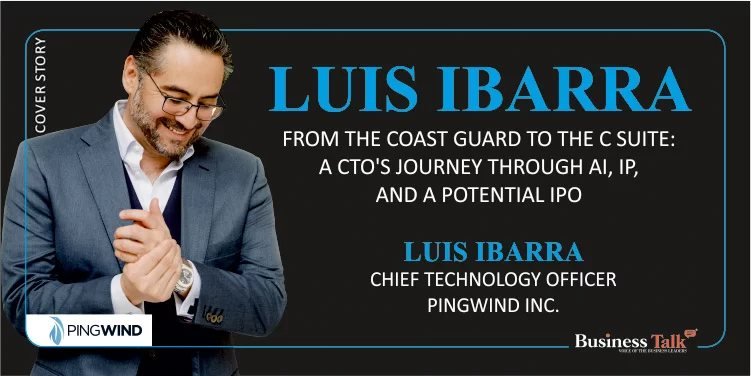
As digital evolution reshapes industries, business leadership is increasingly defined by individuals who can seamlessly integrate technology with long-term vision. At PingWind Inc., Chief Technology Officer Luis Ibarra is leading this transformation by combining his technical expertise with an operator-like mindset forged during his service as a U.S. Coast Guard veteran.
With two decades of experience building mission-critical systems for Fortune 500 companies and federal agencies, Ibarra joined PingWind with a clear mandate. When CEO Aaron Moak invited him to take the role, Ibarra insisted on focusing on product development, patent filings, and long-term technology investments rather than traditional, reactive federal contracting duties. Alongside Lucy Martin, Vice President of Growth, and Efe Lind, Vice President of Solutions, the leadership team established PingWind's dedicated research and development arm, QWind, and its innovation engine, pWind Labs.
Federal Technology and Governance Certifications
PingWind is a certified Service-Disabled Veteran-Owned Small Business (SDVOSB) that delivers enterprise technology solutions, including cybersecurity, cloud engineering, software development, and supply chain management. Over a decade of operation, the company has grown to employ 400 people across more than 30 states, serving U.S. federal agencies and commercial enterprises.
To support its mission-critical operations, PingWind has established a robust governance and quality framework. The company holds ISO 9001 certification for quality management, ISO 20000 for IT service management, and ISO 27001 for information security. It has also achieved CMMI Level 3 ratings for both services and development, alongside a CMMC Level 2 certification, which allows the company to manage controlled unclassified information under strict federal cybersecurity laws. Additionally, PingWind is currently pursuing ISO/IEC 42001 certification, the emerging international standard for AI management.
Addressing AI and Intellectual Property Challenges
The rapid rise of artificial intelligence has introduced complex questions regarding intellectual property (IP) ownership, particularly in highly regulated sectors like legal technology. As AI-assisted workflows become common, organizations face challenges in proving human contribution and protecting proprietary data from entering the public domain. PingWind recognized these market signals early, choosing to focus on how organizations create, protect, and validate AI-assisted ideas.
Through QWind and pWind Labs, the company has focused on AI, High-Performance Computing (HPC), and quantum architectures. A key development in this portfolio is QWindPx, a patented prompt repository that treats AI prompts as valuable assets rather than disposable inputs. The platform routes prompts through a structured process that includes large language model inference, internal uniqueness checks, and patent system IP screening. PingWind has additional AI- and IP-focused patents in its pipeline to build a protected portfolio of innovations.
The Future of Secure AI and Quantum Integration
Looking beyond current technology trends, Ibarra's architectural vision combines elastic cloud systems, knowledge-generating AI, and quantum computing to solve complex optimization and cryptographic challenges. He aims to position QWindPx as a control plane that manages workloads and secures data origin as quantum resources become more practical.
This long-term strategy is designed to transition PingWind from a traditional federal contractor into an AI- and IP-driven enterprise. Ibarra envisions QWindPx eventually operating as an independent platform, which could lead to a strategic spin-out, acquisition, or a future initial public offering (IPO). By focusing on structured governance, continuous R&D, and controlled experimentation, the company continues to build secure technology solutions designed to withstand shifting regulatory and technical landscapes.