From China, Kashmiri Artist Azim Hassan Paints the Changing Landscapes of His Homeland
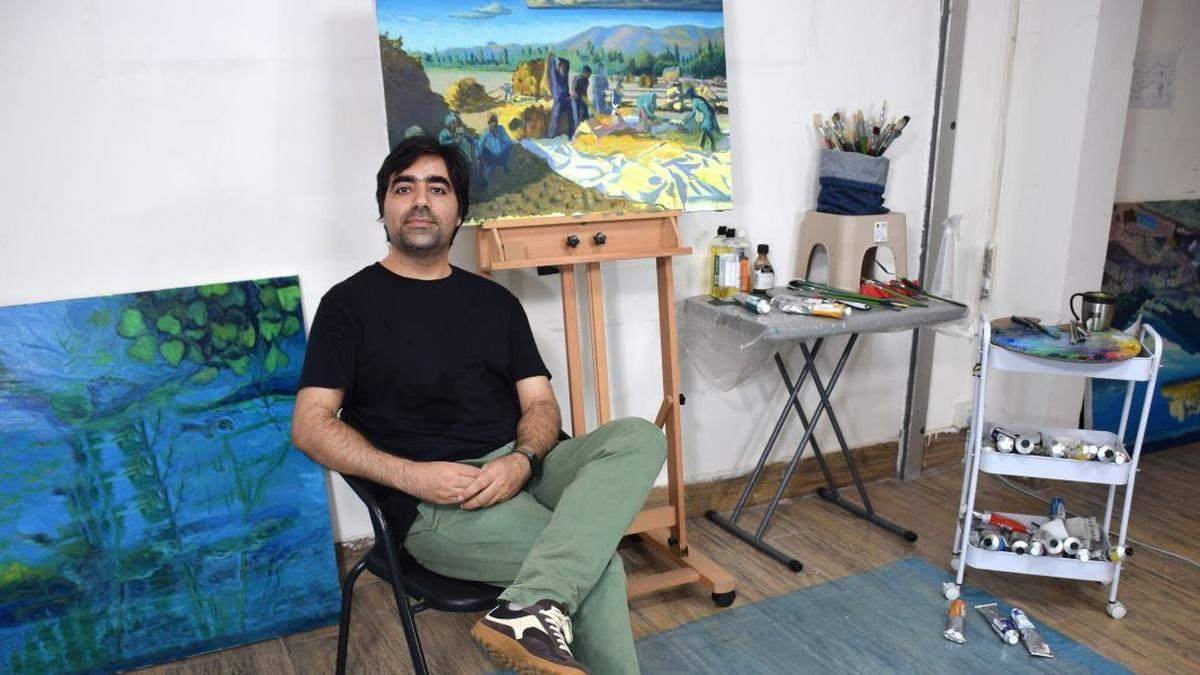
From his art studio in Foshan, located in China’s Guangdong province, 41-year-old Kashmiri artist Azim Hassan captures the changing landscapes, fading traditions, and emotional echoes of conflict in his native region of Anantnag. Through a body of work comprising more than 200 paintings, Hassan explores themes of memory, loss, and transition. His art has been showcased in solo and group exhibitions across several countries, including India, China, South Korea, Pakistan, Portugal, and the United States.
Hassan, who left Kashmir in 2010, uses his distance from home to reflect on the physical and cultural transformations of the Valley. While the panoramic landscapes of Anantnag are now patrolled by soldiers and older architectural structures are replaced by modern buildings, Hassan’s paintings often depict solitary figures set against vast, uncertain backdrops. He describes his creative focus as an attempt to paint "erasure" and capture complex emotional realities.
Exploring Cultural Memory and Conflict
Hassan’s work frequently incorporates traditional Kashmiri architectural and cultural elements that are gradually disappearing. In his painting titled The Dubb and the Nab, he depicts the "dubb," a traditional wooden balcony once common in Kashmir but now largely absent in newer, American classical-style houses. The word "nab" translates to sky in the Kashmiri language. The painting features a marketplace scene that brings together diverse communities, with the primary characters being the Bakarwals, a nomadic pastoral community whose seasonal journeys resonate with Hassan’s own experience of living in China and occasionally returning to Kashmir.
The artist’s first solo exhibition, Four Shadows, held in 2021, focused on what he describes as a "confrontation between beauty and hardship, vulnerability and resilience." One of the central themes in this collection is the interiority of pathos, illustrated through subjects such as an elderly man losing his eyesight while weaving a traditional shawl. Recurring clouds in these works serve as symbols carrying significant emotional weight.
The ongoing conflict in Kashmir also serves as a backdrop for some of Hassan's most evocative pieces. His painting Boy by the Windowside was created in response to the seven months of violence and curfew that affected the Kashmir Valley in 2016. The artwork depicts a boy alongside a blinded cat, representing the visible marks of violence alongside a fragile, temporary moment of peace. The same boy appears in another painting, Beyond the Broken, standing before a window holding a candle.
Artistic Techniques and Educational Journey
Hassan’s visual style is heavily influenced by the interplay of light and shadow, drawing comparisons to the urban loneliness depicted by American painter Edward Hopper. Hassan utilizes chiaroscuro, a Baroque-era technique characterized by strong, bold contrasts between light and dark, to create drama and intensity. Over time, a distinct blue palette has become a signature element of his canvases, which Hassan associates with spirituality, melancholy, silence, and stillness, reflecting his view of Kashmir as a deeply spiritual and mystical place.
While Hassan admires the work of fellow Kashmiri artists such as Shafi Chaman and graphic novelist Malik Sajad, he does not consider his style to be directly influenced by artists from the region. His path to becoming a professional artist involved significant financial and academic challenges. While pursuing a Master’s degree at Jamia Millia Islamia in Delhi, Hassan funded his living expenses through commissioned illustrations. He also received crucial financial support from Nighat Shafi, the head of an NGO in Srinagar, who funded his earlier studies at Kashmir University.
Hassan later secured a competitive scholarship to the China Academy of Art in Hangzhou, where he further developed his technical skills. Today, he works as an International Baccalaureate (IB) art teacher in China, a position that provides him with a stable income and allows him to contribute financially to Shafi’s NGO. After a brief attempt to resettle in Anantnag, Hassan returned to China, where he recently married a resident of Zhejiang province.
Family Roots and the Pull of Home
Hassan’s upbringing in Anantnag was shaped by a supportive family environment, despite the challenges of growing up in a conflict-prone region where newspapers often arrived several days late. Although his parents were not directly involved in his artistic journey, he was raised by his maternal uncle, who actively encouraged his creative pursuits within a liberal, arts-oriented household.
His uncle’s home in Anantnag remains a hub of artistic activity. Hassan’s three younger cousin brothers are all involved in the arts: Numan is a vocalist, composer, and guitarist; Furqan is a composer, keyboardist, and percussionist who has also modeled for Hassan's paintings; and Hanan is an actor. While Hassan has built a life in China, his artwork continues to serve as a bridge to the fading traditions and memories of his homeland.