Crypto Exchanges Expand Pre-IPO Futures Contracts for AI and Robotics Firms

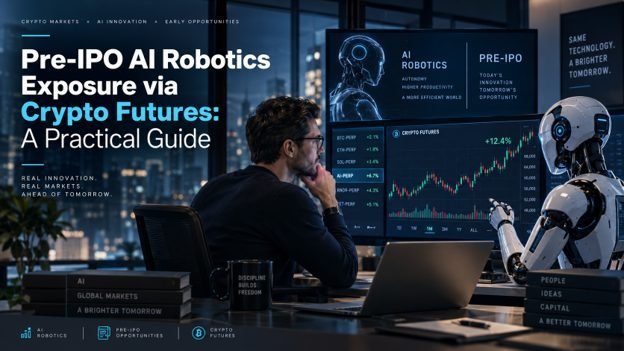
Cryptocurrency exchanges have expanded access to early valuation exposure for private technology firms by offering pre-IPO perpetual futures contracts. The financial instruments allow traders to gain synthetic exposure to valuation shifts in private artificial intelligence and robotics companies without acquiring actual shares, voting rights, or equity ownership.
Retail access to private shares in humanoid and physical-AI companies has historically been restricted due to investor eligibility rules, elevated minimum investment thresholds, and transfer limitations. In 2026, several crypto platforms introduced pre-IPO perpetual futures as an alternative mechanism to gain exposure to company valuations before public stock listings occur.
Market Structure and Trading Mechanics
Pre-IPO perpetual futures are derivative contracts designed to reflect market speculation on a private company's valuation. Most of these products operate as tether-margined (USDT) perpetual contracts without fixed expiration dates. Traders take long or short positions based on expected equity value changes, with profits and losses determined strictly by contract price movements rather than share distributions or dividends.
Holding a pre-IPO contract does not place an investor on a company's capitalization table. The contracts do not include voting privileges, traditional dividend payouts, guaranteed IPO share allocations, or assurances that the target company will complete a public listing.
Activity in the asset class remains concentrated in major private entities. According to data from Binance Research, combined open interest across its Anthropic and OpenAI pre-IPO contracts reached approximately $160 million as of September 15, 2026.
Pricing Mechanisms and Valuation Differences
Because private companies lack continuously traded equity markets, derivative exchanges rely on custom methodologies to establish mark prices and contract valuations. Prior to an official equity listing, contracts like those offered by Binance lack an external price index, drawing mark prices directly from internal platform trading activity and estimated share counts sourced from public filings or prior funding rounds.
As a result, implied valuations derived from pre-IPO futures can diverge substantially from private funding round valuations. Key factors contributing to price divergence include:
- Stale data from historical funding rounds
- Changes in company share counts caused by dilution
- Shifting timelines for anticipated public debuts
- Low trading liquidity, which allows market sentiment to move prices away from private estimates
- Currency conversions when underlying shares are denominated outside United States dollars
Once a company completes a formal public listing, exchange pricing structures transition to reference conventional equity-linked data sources.
Case Study: Unitree Robotics Transition
The mechanics of pre-IPO futures and their post-listing conversion were demonstrated by the trading structure of Unitree Robotics. On July 31, 2026, the crypto exchange MEXC launched UNITREEUSDT Pre-IPO Perpetual Futures. The contract offered up to 10x leverage using isolated margin and 24-hour trading, designed to track a market-implied USD value for a single Unitree A-share without representing an exchange-traded stock.
Following Unitree's initial public offering on August 19, 2026, MEXC converted the UNITREEUSDT contract from a pre-IPO format into a standard futures contract. The transition preserved active trading positions and pending orders, enabling market participants to maintain open exposure without closing and re-establishing positions.
Risk Assessment and Evaluation Factors
Market participants evaluating pre-IPO perpetual contracts face structural risks distinct from conventional equity investments, including leverage risks, carrying costs, and uncertain price discovery. Key evaluation considerations include verifying formal regulatory filings versus media speculation regarding planned IPOs, and assessing contract pricing mechanics against recent private transaction values.
Additionally, liquidity metrics such as order-book depth, bid-ask spreads, and concentration among participants impact trading execution, as continuous 24-hour trading does not guarantee deep order books. Ongoing funding rates and leverage settings also generate holding costs that accumulate over time, while exchange-specific rules dictate how contracts are handled if an IPO is delayed, restructured, or cancelled.