
Bhogapuram’s New Alluri Sitarama Raju International Airport Designed to Withstand Extreme Cyclones

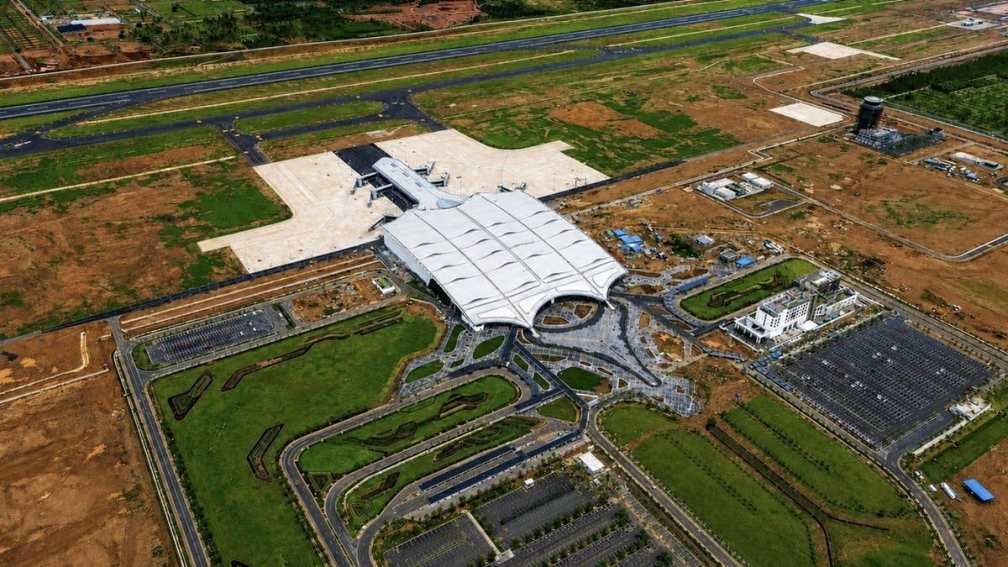
The newly constructed terminal at the Alluri Sitarama Raju International Airport in Bhogapuram, developed by GMR, is scheduled for inauguration by Prime Minister Narendra Modi on August 1, 2026. The greenfield airport project represents a significant expansion of aviation infrastructure and regional connectivity in North Andhra Pradesh, featuring a design heavily influenced by both local cultural motifs and the region's history of severe weather.
Engineered for Extreme Coastal Weather
The architectural and structural choices at the Bhogapuram terminal are directly informed by the impact of Cyclone Hudhud, which struck the Visakhapatnam coast on October 12, 2014. That storm, which brought sustained winds of 185 kmph, flooded the existing Visakhapatnam International (INS Dega) airport, destroyed its radar, and stripped the roof off its terminal.
To prevent similar disruptions, GMR Visakhapatnam International Airport Limited designed the new Bhogapuram terminal to withstand severe cyclonic conditions. The structure is built to sustain wind speeds of up to 275 kmph and heavy rainfall of up to 27 centimeters, supported by a specialized drainage system designed for extreme weather. This specification exceeds the standard Indian building code for this high-wind coastal band, which typically requires designs to withstand winds of approximately 198 kmph, or up to 257 kmph when factoring in post-2014 cyclone safety margins.
The 21-Metre Glass Facade
A key engineering feature of the terminal is its expansive glass facade, which stands 21 meters tall from floor to roof along the coast. Engineered by BES Consultants, the glazing spans range from 12 to 21 meters and are designed to handle wind loads of 5.5 to 5.75 kilopascals.
According to Rajan Govind, Director of BES Consultants, standard cladding fixtures are insufficient for such high wind loads. The engineering team utilized specialized bolt-and-nut systems, reinforced critical panels with perimeter frames, and pinned the top connections. This configuration allows the roof to move during a gale without transferring structural stress to the glass facade.
Aesthetic and Cultural Design Elements
From the air, the terminal's silver roof is shaped like a fish, with a ribbed shell resembling the gill slits of a ray. The building's layout places the check-in area in the "belly" of the structure, while a projecting pier for aerobridges forms the "tail."
Inside, the terminal incorporates traditional cultural elements from Andhra Pradesh. The arrivals level features a massive muggu (traditional Rangoli) pattern inlaid in dark granite. The scale of the white stone loops is so large that passengers walking across the floor cannot perceive the full pattern, which is only fully visible from the overhead balcony. Similar stepped geometric turns are integrated into the ceilings using brass light channels set against timber-look battens.
In the departures hall, a continuous LED band is positioned above the check-in rows, displaying digital imagery of the gopurams of Tirupati and Simhachalam above a fixed band of floral relief. The central atrium features an oval skylight from which approximately 27 spoked, parasol-like discs hang at varying heights. Some of these discs are printed in cream, rose, slate, and grey, while others feature an open mesh design to filter natural light.
Landscaping and Forecourt Gardens
The airport's exterior landscaping features garden beds cut in loops across the forecourt, with wide banks of grass running along the approach road to mirror the curves of the terminal roof. While the outdoor trees remain young saplings, indoor greenery is arranged in pots at the base of the central atrium, offering a scaled-down variation of the integrated garden concepts seen in other regional terminals.