AI Crowds in Indian Films May Cut Junior Artiste Jobs, Bollywood Entry Point
Every actor has an origin story. For some, it begins in a crowd. Mithun Chakraborty once worked as a junior artiste in several films in the mid-1970s. Nawazuddin Siddiqui's early film credits included a small role as a waiter in Shool, followed by years of minor and uncredited parts. Pankaj Tripathi, too, started with small roles before becoming one of Hindi cinema's most recognisable actors.
More recently, Mihir Ahuja also took the same long route. He had a small role in Hrithik Roshan-starrer Super 30, long before he became a familiar face to audiences. Then there is Kalpa Latha, who was an extra in SS Rajamouli's Baahubali. She played an inhabitant of Mahishmati and, despite having no major role, became a familiar face in the film.
These may now look like neat success stories in hindsight. But for thousands of aspiring actors in Mumbai, being a junior artiste or an extra is not necessarily about becoming the next big star. For years, it has been Indian cinema's most accessible entry point. For many, it is a way to pay the bills while chasing a dream that may take years — or may never come true.
The Rise of AI-Generated Crowds
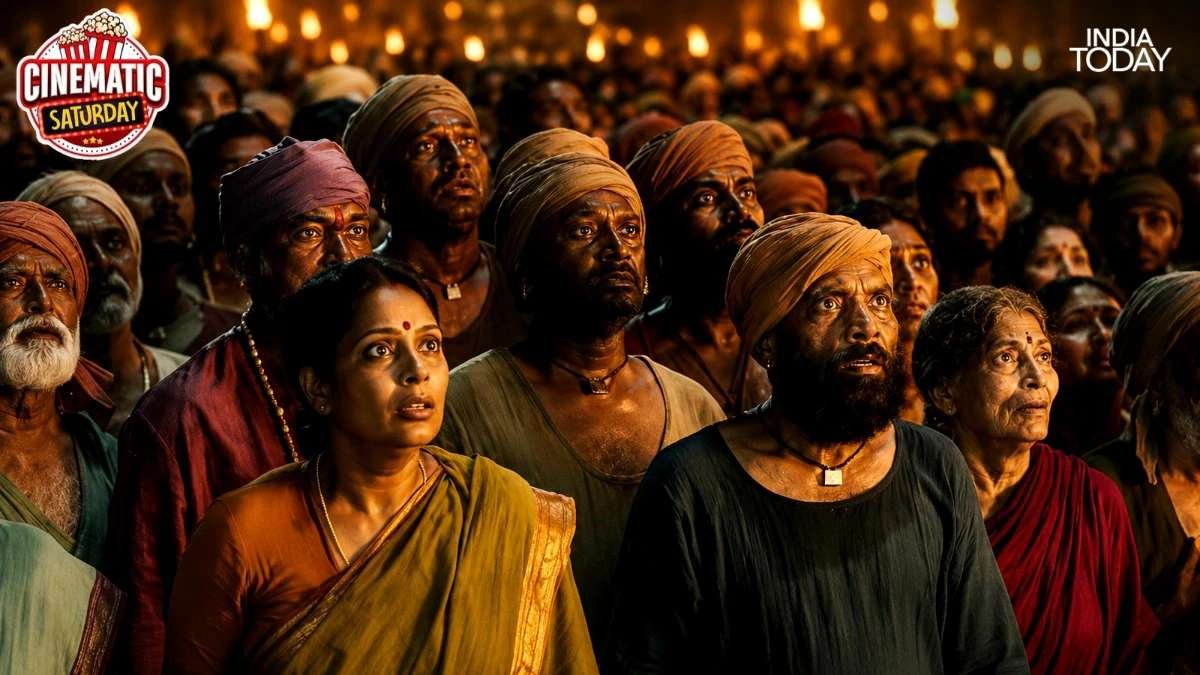
The rise of AI-generated crowds deserves a closer look. If a scene that once needed 300 people can now be created with 60 real artistes and the rest digitally, what happens to the other 240?
According to Akhilesh Jain, Head of Visual Effects at Squad VFX, Indian films are already using AI in crowd creation. He cited Kannappa, Border 2, and Gadar 2, the films he has worked on, as examples where the technology has been used in some form. And the numbers can be striking.
Jain said that in certain crowd-multiplication situations involving more than 100 people, around 20 per cent of the crowd could be real, with the remaining 80 per cent created digitally. He also shared that producers are increasingly asking VFX teams about crowd multiplication when a scene requires more than 100 people. The reason is fairly simple: money.
The economics are obvious. Hiring hundreds of people means paying for their work, costumes, transport, food, make-up, and all the logistics that come with putting a large group on a set. AI can reduce those costs.
In fact, Jain estimates that using AI for crowds can work out cheaper than hiring 200 to 500 junior artistes for certain sequences. Stadium scenes and large-scale action sequences could therefore be among the areas most affected.
The Human Factor
There is another development that makes this more interesting and potentially more complicated. A small number of real artistes can be 3D-scanned, capturing their facial structure, body proportions, skin, expressions, and movement. Those scans can then become the raw material for creating hundreds or thousands of digital humans.
So the human being has not entirely disappeared. They have simply become the source material. And that throws up a new question: once an actor's face and body have been digitally captured, who owns that digital version?
Jain said that, in current Indian productions, the production house owns it, with proper consent being taken from artistes before their likeness is used. That consent question could become increasingly important as digital doubles become more common.
The Future of Junior Artistes
For actor Mihir Ahuja, who is being praised for his role as Baldy in Operation Safed Sagar, this isn't an abstract debate. Before audiences knew him from his more recent work, Ahuja was himself part of the background. He worked as a background actor in Super 30, which starred Hrithik Roshan in the lead role.
His response to AI is particularly personal. Ahuja is not against the technology itself. He accepts that AI can have useful applications in filmmaking. But he draws a line when it comes to replacing human performers.
"AI does not have emotions. It cannot show clear emotions, it cannot portray them the way we do," he said. Then comes his rather cinematic response: "I'm not scared of AI. AI should be scared of me."
It is a good line. But the immediate threat may not be to actors like Ahuja. It could be to the person who has not even got his first Super 30 yet. And if that first day on a film set disappears, how does the journey begin?
AI Isn't Just About Crowds
There is, however, a catch. AI may be getting better at creating crowds, but it is still nowhere near replacing real people in every kind of shot. Srinivas Mohan, the VFX head behind the Baahubali films, has a simple rule: the closer a person gets to the camera, the harder it becomes to fake them convincingly.
"AI still cannot give us very high-quality results," Mohan said, explaining that it therefore needs to be used carefully, particularly for distant elements.
So the junior artiste is not disappearing tomorrow. But that does not necessarily make the larger concern go away. If AI can convincingly create the people who are too far away for audiences to notice, then those are precisely the people whose jobs are easiest to remove.
The closer you get to the camera, the safer your job may be. But what about everyone standing behind you?
Then there is Christopher Nolan's The Odyssey. The most interesting counterpoint to all of this comes from one of the world's most celebrated filmmakers. Christopher Nolan was recreating the Trojan War for The Odyssey and needed enormous armies and crowded battlefields and a scale that would be difficult and extremely expensive to achieve with real people.
For the siege of Troy, Nolan used around 2,000 extras. Cast members have spoken about arriving on set and seeing thousands of people in costume, hundreds of boats, and a full-scale world built around them. Matt Damon recalled seeing thousands of people on his first day of shooting in Morocco and said Nolan simply does not put people in by computer when the scene calls for thousands.
That said, Nolan is working at a scale most Indian productions cannot simply replicate. The Odyssey was a huge international production, but the contrast is worth noticing.
While one filmmaker is asking how to make a crowd feel real. Another industry is figuring out how to make the crowd smaller. And somewhere between those two approaches is the junior artiste in Mumbai, waiting for the next call.
AI isn't just about crowds. The biggest transformation may not even be happening on the set. Mohan said that AI is already proving useful during pre-production. Earlier, a director with a visual idea had to explain it to a concept artist, who would create a reference image before the production designer and VFX team could start working on it.
Now, directors, assistant directors, cinematographers, and art departments can generate visual references almost instantly. "They can actually show us what they are thinking," Mohan said, making communication faster. AI can also assist with tasks such as rotoscoping, where people or objects are separated from their backgrounds, and relighting shots.
So this is not about making technology the villain. It is about what happens when efficiency begins to remove the people who were never considered expensive enough to worry about.
For a junior artiste, losing a day's work can matter far more than it might seem. For someone chasing a break in Mumbai, those crowd shoots can help keep the dream alive. What if the dream survives, but the work that allows you to survive while chasing it doesn't? And, this is the uncomfortable part of the AI revolution.
The crowd may not disappear. But it may get smaller. No one we spoke to believes junior artistes are about to vanish completely. That makes it difficult to put a fixed price on AI-assisted work. There is also the danger of treating AI as a shortcut.
Jain estimates that 20 to 30 per cent of a crowd may still need to be real. Mohan believes AI is most useful for distant figures. Dipankar Mukherjee, co-founder and CEO of Studio Blo, argues that cinema has always used technology to change how many people are needed for a scene.
He points out that even before AI, filmmakers did not necessarily put 10,000 people into a stadium scene. A smaller group could be filmed and multiplied using VFX. What AI changes is the ease and scale of that process.
Mukherjee, who has worked with Atlee for Ranveer Singh's Ching's advertisement, also believes the industry will create new kinds of work as technology changes old ones. But he warns against treating AI as a shortcut.
"If you don't put craft into it, it will look very fake," he said. That may be true. But for the junior artiste, the issue is not whether an AI-generated crowd looks fake. It is whether there is still a real person standing behind it.
Because the Mumbai film industry has always sold a particular dream: that you can arrive with very little, stand in the background long enough, and, one day, find your way towards the front.
Nawazuddin did it. Pankaj Tripathi did it. Mithun Chakraborty did it. Kalpa Latha did it. Thousands are still trying.
They may wait for years and may never become stars. But at least, for now, there is still a crowd to join. And that raises a simple question as AI gets better at creating crowds: If the crowd is where many actors get their first chance, are we making cinema bigger while making its entry gate smaller?