Special Intensive Revision of Electoral Rolls Sparks Mass Disenfranchisement Concerns

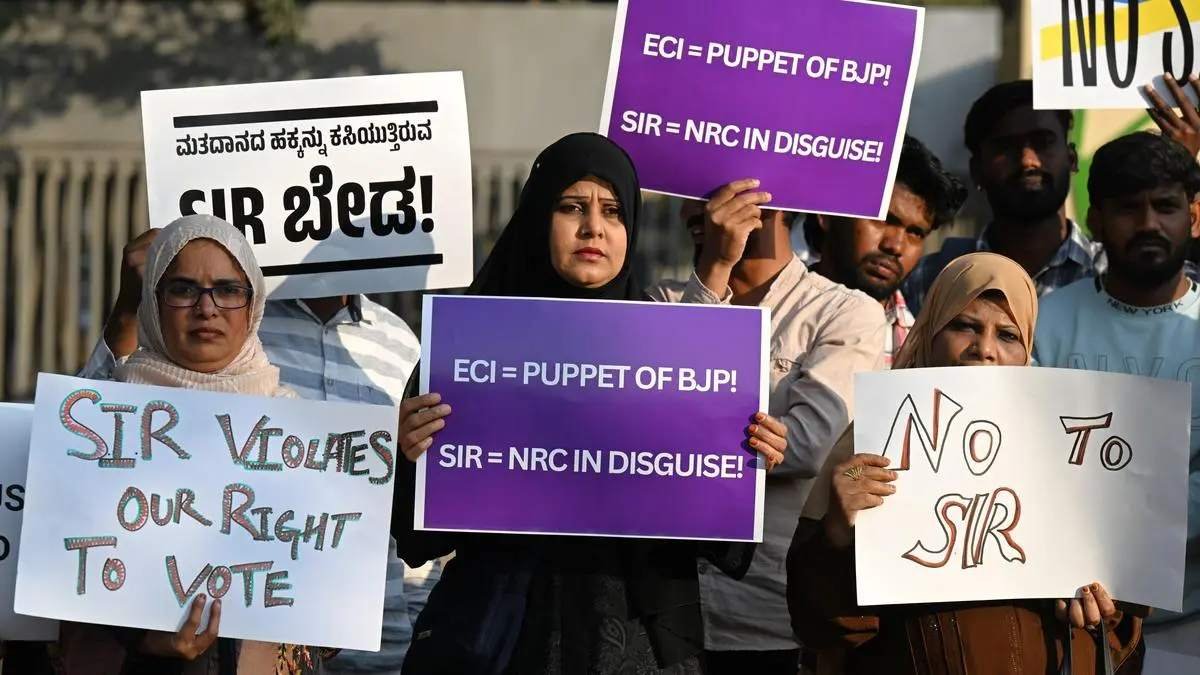
The implementation of the Special Intensive Revision (SIR) of electoral rolls across India has raised serious concerns among activists and researchers regarding the large-scale deletion of voters. Activists from various groups staged a protest against the SIR at Freedom Park in Bengaluru on Saturday, February 7, 2026, highlighting the scale of these deletions and the potential for mass disenfranchisement.
Estimates suggest that nearly 13 crore names have already been deleted from the country's existing electoral rolls, with another one crore potentially joining the list before the process concludes. This comes alongside existing exclusions, where approximately 98 per cent of the estimated 15 crore denotified, nomadic, and semi-nomadic tribes (DNTs) are already missing from the electoral rolls. The addition of roughly 14 crore deletions through the SIR process threatens to further expand this excluded population.
Staggering Deletion Figures Across States
Data compiled from various states reveals a significant volume of voter deletions. Uttar Pradesh leads with 2.89 crore deletions, followed by Maharashtra with 2.06 crore and Karnataka with 1.07 crore. Other states have also recorded substantial numbers: West Bengal saw 93 lakh deletions; Tamil Nadu, 97 lakh; Gujarat, 77 lakh; Telangana, 73 lakh; Bihar, 65 lakh; Madhya Pradesh, 45 lakh; Rajasthan, 44 lakh; Andhra Pradesh, 44 lakh; and Kerala, 24 lakh.
In terms of percentages, several regions have seen their electorates shrink dramatically. Delhi's electoral roll has shrunk by 35.89 per cent, representing 47.5 lakh deletions, while Chandigarh's decreased by 31.84 per cent. The Andaman and Nicobar Islands saw a deletion of 22.32 per cent, Arunachal Pradesh 19 per cent, Haryana nearly 16.38 per cent (about 34 lakh), Jharkhand nearly 16.5 per cent, Goa 11.78 per cent, and Puducherry 11.67 per cent. Data from Nagaland and Tripura are still awaited, while Himachal Pradesh, Jammu and Kashmir, and Ladakh have yet to begin their SIR process.
Discrepancies and Investigative Findings
While some media outlets, citing Election Commission of India (ECI) sources, have published net numbers that factor in newly enrolled voters to mitigate the apparent scale of deletions, independent investigations have pointed out severe discrepancies. The Sabar Institute revealed that in two Assembly segments of the Hyderabad Lok Sabha constituency, the number of deletions exceeded the total votes cast in the 2023 Assembly election. In Malakpet, where 1,32,024 votes were polled in 2023, the SIR deleted 1,47,799 voters. Similarly, in Yakutpura, 1,54,982 voters were deleted compared to 1,40,434 votes polled in 2023. In Delhi's Chandni Chowk Assembly Constituency, Polling Booth number 33 saw 908 out of 909 votes deleted.
Investigative studies have also shown that many individuals listed as dead are actually alive, with some presented to the Supreme Court following the Bihar revision. A study by The Hindu in Tamil Nadu found that the ages of those marked as deceased did not align with official mortality trends. In West Bengal, numerous deleted voters listed as dead, shifted, or absent protested at local government offices.
Furthermore, in Bihar, the revised electoral roll contained 1.32 crore fake addresses. In Barachatti constituency, 877 voters were registered at a single village address, while in Pipra constituency's Galimpur village, 509 voters were registered at a non-existent address. Across all 243 constituencies in Bihar, investigative journalists discovered 14.35 lakh duplicate voters after the ECI termed the exercise "successful."
The Question of Foreigners and the Assam Exception
The ECI's claim of weeding out infiltrators or foreigners has also faced scrutiny. In Bihar, out of 1,087 objections raised against suspected foreigners, only 390 were accepted for verification. Of these, only 76 were Muslims. In the Seemanchal region, only 10 objections were verified, of which five were Muslims, two of whom were deceased, leaving only three individuals identified as foreigners.
Despite citizenship being a highly contested issue in Assam, the ECI decided to conduct only a Special Revision (SR) in the state, rather than the more rigorous Special Intensive Revision (SIR). Additionally, the Supreme Court directed on May 27, 2026, that the ECI refer suspected foreign cases to the Competent Authority under the Citizenship Act, 1955, within four weeks. More than three months later, the ECI has yet to make any such list public.
Comparison with the 2002 Revision
The ECI has defended the current exercise by comparing it to a revision conducted in 2002. However, when activists filed a Right to Information (RTI) request to compare the guidelines, the ECI responded that it had no copy of the 2002 guidelines.
Furthermore, the 2002 exercise was officially termed a "Special Revision of an intensive nature," which required transparency by vetting changes against the existing "mother list" openly in gram sabhas and ward committee meetings, unlike the current SIR process.