Spanish Transport Minister Resigns Following Fatal High-Speed Train Crash

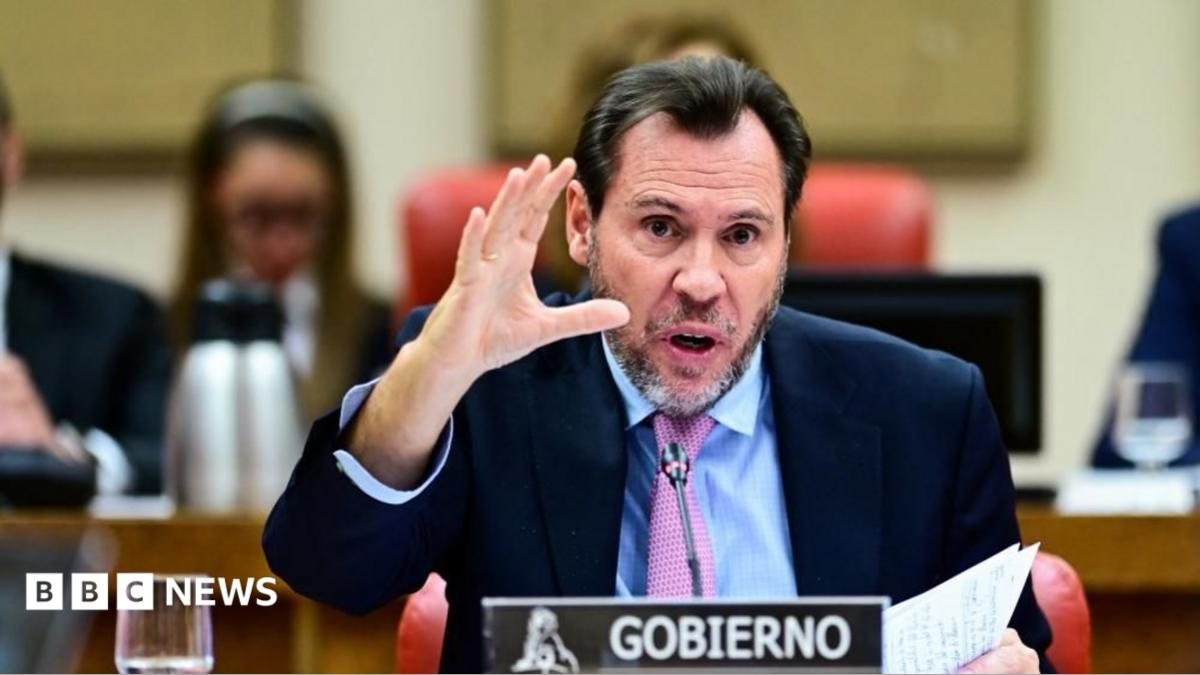
Spain's Transport Minister Óscar Puente has resigned six days after a high-speed train collision south of Madrid left at least 69 people dead and dozens injured. He made the announcement in Congress at the conclusion of a parliamentary hearing regarding the disaster that occurred last Wednesday near the town of Urda.
"A transport minister in a country like Spain cannot remain in office after two accidents of this seriousness in less than a year," Puente stated, referencing both the recent disaster and a separate deadly rail crash that took place in January in Andalusia, southern Spain.
Details of the Urda Collision
The collision occurred when a state-operated Renfe high-speed train carrying 397 passengers struck the rear of a stationary train operated by the private company Iryo, which was carrying 147 passengers. Iryo confirmed that its carriages were "struck from behind" by the approaching train.
A computer failure in the automatic signalling system had initially forced all trains along the affected stretch to come to a halt. However, the Renfe train was subsequently ordered to proceed in what Puente described as an "error." Puente had previously characterized the instruction allowing the trains to move again without speed restrictions as "inexplicable."
Leaked Audio Recordings Reveal Control Exchanges
Leaked audio recordings published by Spanish media outlets, including El Pais and RTVE, captured conversations between Madrid's control centre and the train drivers prior to the impact. The three recordings indicate that the Renfe train was given clearance to move while the Iryo train remained stopped on the track roughly 25 kilometres (15 miles) ahead.
In one recording, a control centre operator instructed the Renfe driver to "Continue your journey and then proceed under [Lateral Signalling Block], at normal speed with normal operation." When the driver queried, "At normal speed?" the controller affirmed, "Yes." The Lateral Signalling Block serves as a back-up protocol when automated data transmission systems fail.
In a separate recording, the driver of the Iryo train informed the controller that their train was stationary in front of the entry signal at Urda due to a loss of communication with the train-control system. In a subsequent exchange, the Iryo driver noted, "The train won't allow me to control the [security] system. That's why I am still stopped in front of the entry signal." This recording indicates that controllers were notified that the Iryo train was unable to move as the Renfe train advanced towards it.
Political Impact and Election Withdrawal
Puente disclosed during his appearance before lawmakers that he had decided to step down immediately following the 28 October disaster, though he chose not to make the decision public at the time. His resignation followed growing demands from opposition politicians and government allies for him to vacate his post.
"I wish to inform you that I am not only stepping down from my position as minister of transport, but that I am also withdrawing my name from the lists for the early legislative elections," Puente announced to Congress. His departure presents a challenge for the Socialist-led government ahead of Spain's general election scheduled for 29 November.
The incident represents one of the most severe rail disasters in Europe's modern history and Spain's deadliest crash since 2013. Spain previously marked three days of national mourning following the event. Prime Minister Pedro Sánchez stated that authorities will "get to the bottom of every last detail of this tragedy."