
Pek Automotive Advances Autonomous Electric Vehicles for Agriculture and Civil Defence

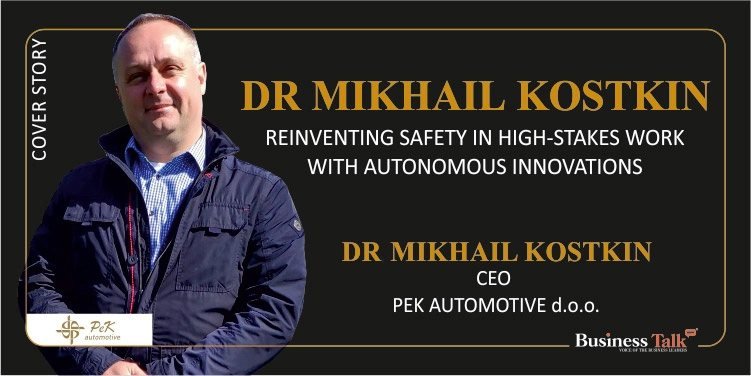
Pek Automotive d.o.o., a European developer of customized autonomous mobiles and electric vehicles, is expanding its footprint in the agricultural, defence, and humanitarian sectors. Under the leadership of CEO Dr Mikhail Kostkin, the company focuses on designing emission-free and GNSS-free automotive technology. These systems are engineered to perform high-stakes operations in challenging environments, ranging from steep agricultural slopes to active civil defence and rescue zones.
The company’s core mission centers on reducing labor requirements while improving safety and operational efficiency. By developing specialized robotic platforms, Pek Automotive aims to support personnel tasked with demanding physical labor and hazardous missions, offering technology designed to save time, resources, and preparation readiness.
The Agricultural Foundation: Agroline and Agrobots
Pek Automotive began its journey by establishing its "Agroline" pillar. The company’s founders spent years working on various special-purpose projects with the goal of building socially beneficial technology. This research eventually led to the creation of agricultural robotic systems capable of year-round operations. The development was inspired in part by early prototype deployments in remote areas, which highlighted the potential for robotics to transform traditional agricultural cycles.
Today, the company’s agricultural portfolio features two primary autonomous agrobots: the Slopehelper and the Agilehelper. Together, these machines are designed to cover the complete agrocycle:
- Slopehelper: This vehicle is designed to replace a standard fleet of agricultural machinery, such as tractors, sprayers, harvesters, and mulchers. Built on a modular base platform, it utilizes interchangeable attachments to perform a wide range of tasks, including soil preparation, pruning, spraying, mowing, fertilization, and harvesting.
- Agilehelper: Sharing a similar customizable design, this platform is specifically optimized for operations in small- to medium-scale vineyards and plantations.
Expanding into Civil Defence and Specialized Vehicles
Building on the technology developed for its agricultural platforms, Pek Automotive has expanded its portfolio into civil defence, rescue, and logistics. The company has designed a pipeline of specialized autonomous vehicles to address specific system-level challenges:
- DeMiner: A lightweight, electric unmanned ground vehicle (UGV) equipped with a mechanical flail system. It is engineered to provide a fast, safe, and cost-effective solution for mine clearance operations.
- LUGV: A rugged UGV designed specifically for demanding logistics operations in austere and difficult environments.
- FFRS (Firefighting Robotic System): A specialized robotic firefighting platform equipped with a foam generator, a 1700-litre water tank, and a 170-litre foam concentration tank.
- Vanquisher: An all-terrain, amphibious electric vehicle engineered to transport heavy payloads through extreme environmental conditions, including snow, mud, sand, and water.
In addition to these physical platforms, Pek Automotive provides tailored Enterprise Resource Planning (ERP) systems to simplify complex manufacturing operations. It also offers custom electric vehicle development technologies and advanced manufacturing equipment for businesses focused on small-batch production.
Vertical Integration as a Business Model
A key element of Pek Automotive’s operational strategy is its commitment to complete technological sovereignty. Unlike manufacturers that assemble vehicles using outsourced components, Pek Automotive develops every mechanical element, electronic system, and software layer in-house. This vertical integration model allows the company to design and build its systems from the ground up, ensuring that all components are fully optimized for system-level tasks.
This in-house development model is supported by a feedback system that integrates insights from direct sales and a broad distribution network. By analyzing real-world performance and customer input, the company refines both its product features and its commercial strategies. Rather than simply reacting to current market demands, the development cycle incorporates forward-looking insights from farmers, operators, and defence specialists to anticipate future operational needs.
Structured Leadership and Operational Philosophy
Operating in the rapidly evolving robotics and autonomous vehicle sector presents unique organizational challenges. To maintain stability and focus, Dr Kostkin has established a structured, vertical hierarchy at Pek Automotive, supported by precise key performance indicator (KPI) tracking and performance analytics for all employees.
Dr Kostkin emphasizes a disciplined, contingent approach to strategic decision-making, stating that leadership must "never allow a decision to trap the company in a dead end." Under this philosophy, strategic moves are designed to be fully reversible or backed by multiple exit routes to ensure long-term resilience.
The company’s internal culture encourages employees to focus on concrete results, rewarding curiosity and active problem-solving. Issues identified during the development stage are treated as opportunities, with financial incentives aligned with successful outcomes. Dr Kostkin also maintains an unconventional view of mentorship, describing human beings as self-educating entities who must rely on their own minds rather than blindly following external guidance. In this context, he views artificial intelligence as a tool to expand decision-making capabilities by providing a wide variety of historical cases for analysis.
Market Validation and Future Outlook
Pek Automotive measures its success primarily through market validation and business valuation. In five years of operation, the company has achieved a valuation that reflects its rapid scaling and product demand. This growth builds upon the founders' long-term experience in developing R-Wave Technologies for Autonomous Electric Vehicles (AEVs), which dates back to 1998.
Looking ahead, Pek Automotive is preparing for shifting global priorities, particularly an increasing shortage of manual labor in agriculture and rising demand for civil defence systems. The company’s roadmap includes expanding its agricultural technologies into full-scale crop production. In the civil defence sector, it plans to scale its autonomous logistics, firefighting, and demining technologies. The next phase of product development will focus on reducing the cost of these system-level solutions by incorporating computer vision, innovative materials, and AI technologies.