Nepal Floods: Rescuers Continue Search for Missing as Identification of Dead Remains a Challenge

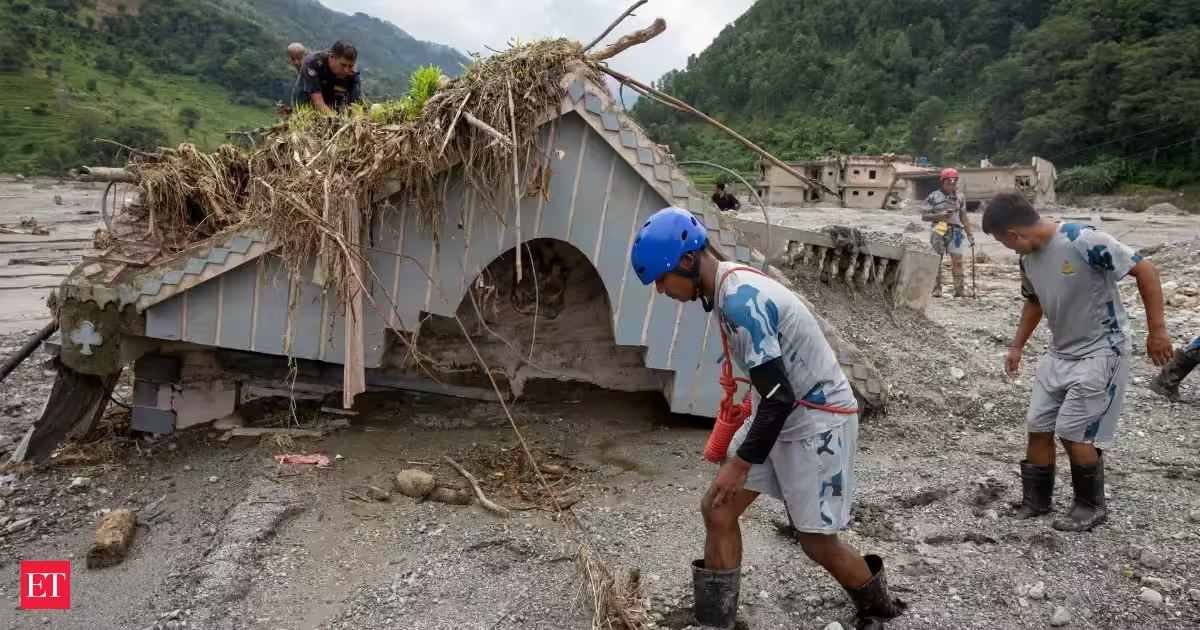
Kathmandu: Rescuers in Nepal continued searching for those missing, as authorities faced continuing difficulties in identifying the dead, 11 days after devastating floods struck large parts of the country.
The death toll stood at 1,344, while nearly 5,000 people, including 589 foreign nationals, remained missing, according to Nepal Police. Around 13,400 people have been rescued so far.
Disaster Aftermath
The disaster was triggered by an ice-rock avalanche near the Nepal-Tibet border on August 26, sending a massive surge of water and debris downstream through the Bhotekoshi River and devastating settlements in northern and central Nepal.
Homes, vehicles, roads, bridges, and hydropower infrastructure were swept away or damaged. At least 43 people were killed on the Chinese side, while more than 500 people remained missing in Tibet, according to Chinese media reports.
Identification Challenges
Of the bodies recovered in Nepal, at least 85 were children, while around 500 were recovered with body parts missing, according to officials. The condition of many bodies has complicated efforts to establish their identities.
Chitwan district accounted for the largest number of recovered bodies, with 362, followed by other affected districts including Nawalparasi East, Nawalparasi West, Nuwakot, Rasuwa, Gorkha, Dhading, and Tanahun, according to Nepal's National Disaster Risk Reduction and Management Authority (NDRRMA).
Only 98 bodies had been identified and handed over to their families, according to NDRRMA.
Relief Efforts
Nepal Police has begun collecting DNA samples from relatives of missing people to help identify unclaimed bodies and human remains recovered after the floods.
Relatives in Nepal can provide samples through the Nepal Police Hospital in Kathmandu or their nearest district police office.
More than 1,000 unidentified bodies have been buried after DNA samples were collected to facilitate their identification in the future, officials said.
Government Response
Nepal's Information and Communication Minister Bikram Timilsina has said the government would ensure that there was no shortage of relief materials or mismanagement in their distribution to flood victims.
The government was actively involved in relief and rehabilitation efforts despite the scale of the disaster, Timilsina told the online edition of the government-owned Gorkhapatra.
Nepal demands climate justice at this moment and the international community should be serious about this, Timilsina said, adding that the disaster underscored the need for greater preparedness for future climate-related disasters.
Alternative Routes for Supplies
Nearly 88,000 cooking gas cylinders have been brought into Kathmandu Valley through alternative routes over the past three days as authorities work to maintain supplies after the disruption of the Prithvi Highway.
According to Nepal Oil Corporation (NOC), 87,877 LPG cylinders were brought into the Valley between September 3 and September 6 by 18 companies.
The cylinders were filled at plants in Bara, Parsa, Makawanpur, Chitwan, Nawalparasi, Dhanusha, and Mahottari districts before being transported to Kathmandu.
NOC spokesperson Manoj Thakur said supplies of petroleum products and LPG to Kathmandu Valley and surrounding areas were continuing through alternative routes despite the disruption of the main highway.
International Support
Nepal's Foreign Minister Shisir Khanal and his South Korean counterpart Cho Hyun on Sunday discussed ongoing search, rescue, and relief operations.
In their meeting in Kathmandu, the two leaders held in-depth discussions on efforts to locate missing South Korean nationals, Khanal's office said.
Khanal thanked the South Korean government for sending an inter-agency rapid response team and the Korea Disaster Relief Team to flood-hit areas, as well as for providing humanitarian assistance and relief materials.
He also outlined Nepal's priority of rebuilding resilient and durable infrastructure and expressed hope for continued South Korean support.
Cho expressed the willingness of the Korean Government to support Nepal in the post-disaster reconstruction efforts and called for Nepal and South Korea to work together to raise awareness about the impacts of climate change, including at global forums such as COP.
Travel Advisory
Kathmandu has urged friendly countries to confine travel advisories to specific flood-affected areas, while highlighting that the rest of the country remains open and safe for travel and tourism.
The country's Ministry of Foreign Affairs said on Sunday that it and Nepal's missions abroad were working closely with friendly countries on the issue.
The request comes after the United States issued a travel advisory on September 4, placing entire Nepal under Level 2, or Exercise increased caution, due to natural disasters.
Tourism is a major contributor to Nepal's economy, accounting for about 6.4 per cent of GDP and 15.2 per cent of total employment in 2024, according to World Bank data, making travel restrictions a significant concern for the country.
Fresh Flood in Gorkha
A fresh flood in Gorkha district early Sunday swept away four houses and a suspension bridge, although there were no casualties.
The flood occurred in Chumnubri Rural Municipality-4 after the Namrung Khola River overflowed, according to police.
The four houses were swept away after residents became aware of the approaching flood and fled to safety.
Authorities said the river may have been temporarily blocked near its source before releasing a surge carrying mud and debris downstream.
The Namrung Khola flows into the Budhigandaki River, and residents along the Budhigandaki have been urged to remain alert.
The flooding damaged two small hydropower projects in the wider Namrung area, according to local reports.
It also affected movement in the area after the suspension bridge was swept away.