Durga Puja: Where Sacred Meets Secular in Bengal

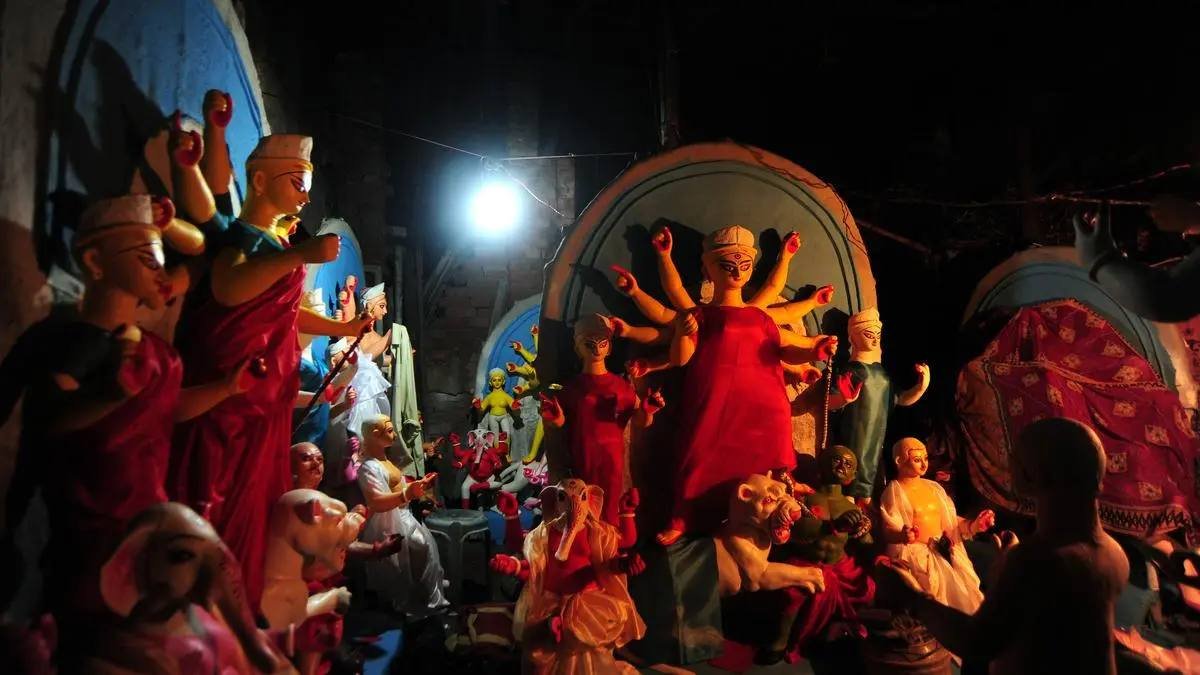
In Bengal, the festival of Durga Puja is a time of great celebration and cultural expression. For four or five days each autumn, the streets of Kolkata and much of West Bengal are transformed into a vibrant public space, filled with art, music, and community spirit.
At its heart, Durga Puja is a Hindu religious festival, but its appeal extends far beyond the boundaries of faith. It is also a public carnival, an artistic extravaganza, and a collective expression of Bengali life.
The festival's history reflects the changing social and cultural life of Bengal, from its origins as a household ceremony to its current status as a community celebration. Over time, worship has moved from the private courtyard to the public arena, with the emergence of barowari puja, a community-organised celebration supported by subscriptions collected from local people.
Today, Durga Puja is a public institution as well as a religious observance, bringing together people from different occupations and social backgrounds. The festival's social significance lies in its capacity to create shared experiences without erasing the inequalities of everyday life.
As the festival continues to evolve, it remains a powerful symbol of Bengal's cultural identity and its ability to hold together different, sometimes conflicting, elements of its cultural life. It is a reminder that tradition and modernity are not mutually exclusive, and that a secular public culture can accommodate religious faith and artistic expression.
The Evolution of Durga Puja
The transformation of Durga Puja into a public festival did not happen overnight. Its history offers an important clue to understanding how it came to embrace both religious tradition and secular celebration.
For centuries, Durga worship in Bengal was closely associated with the household and the landed elite. Wealthy families organised elaborate ceremonies, while rural communities observed the festival in ways closely connected with agricultural life and the rhythms of the harvest.
Over time, a significant change took place: worship moved beyond the private courtyard into the public arena. One important development was the emergence of barowari puja, a community-organised celebration supported by subscriptions collected from local people.
According to a widely cited account, 12 friends in Guptipara, in present-day Hooghly district, came together in 1760 to organise a Durga Puja. The term barowari is traditionally associated with this group of 12.
The Social Significance of Durga Puja
The story of Durga Puja is also a story of social relationships. Historically, the festival depended on the contributions of people from different occupations and social backgrounds.
Priests, artisans, musicians, craftspeople, and service providers all played their part in making the rituals possible. The dhak, the large traditional drum whose rhythms have become inseparable from the sound of Durga Puja, offers a revealing example.
The making of drums required specialised skills, including the preparation of animal hide. Communities associated with leatherwork and other occupations regarded as socially inferior under the caste system contributed to the material and musical traditions of the festival.
The sounds of the dhak are now celebrated as an essential part of Bengal's cultural identity. Yet behind those sounds lies the labour and inherited knowledge of communities whose social standing has often been marginalised.
Tradition and Modernity in Durga Puja
There is another reason why Durga Puja continues to command such widespread enthusiasm. It has never remained frozen in a single historical form.
The festival draws on religious narratives, inherited rituals, and established artistic conventions. At the same time, it constantly absorbs new ideas, technologies, and cultural influences.
Traditional images of the goddess appear alongside experimental sculpture, contemporary installations, innovative lighting, and themes drawn from world events.
This mixture is sometimes viewed as a departure from religious tradition. But it can also be understood differently. A living tradition survives not simply by repeating the past, but by finding ways to make the past meaningful in the present.
The Secular Character of Durga Puja
Secularism here does not necessarily mean the absence of religion. Rather, it describes a public cultural space in which religious symbols coexist with art, social concerns, and forms of participation that cannot be reduced to worship alone.
The festival's public character allows it to speak to people in different ways. For some, it is primarily an occasion for religious devotion; for others, it is a celebration of Bengali identity, artistic achievement, friendship, or the pleasures of the city.
Many experience several of these dimensions at once. What Durga Puja tells us about Bengal is that it is a society that can hold together different, sometimes conflicting, elements of its cultural life.
It is religious without being confined to the religious. It is modern without abandoning inherited traditions. It celebrates a particular cultural identity while creating a public space in which participation can extend beyond the boundaries of religious observance.
The social significance of Durga Puja lies in its capacity to create shared experiences without erasing the inequalities of everyday life. This does not make Bengal free from communal tensions, caste divisions, or social inequality.
The inclusive spirit associated with Durga Puja should not obscure the persistence of these problems. Nor should the commercialisation of the festival be ignored.
Yet the festival continues to offer something valuable: a shared experience that cannot be fully explained by commerce, ritual, or entertainment alone.
Its significance lies in the way these elements interact. The sacred gives the festival continuity; the carnival gives it energy; art gives it a changing visual language; and public participation gives it a social life beyond the household and the temple.
Perhaps this is the enduring lesson of Durga Puja. A tradition need not retreat from the modern world to preserve its meaning, and a secular public culture need not erase religion to create room for people with different interests and experiences.
Every autumn, Bengal stages this encounter anew. The goddess arrives amid the sounds of the dhak, the glow of the lights, and the bustle of crowded streets.
Around her, the world of worship merges with the world of art, fantasy, and everyday life. For a few remarkable days, the sacred and the secular do not stand on opposite sides of a boundary.
They inhabit the same public space, each giving the other a new meaning. That, more than any single ritual or spectacle, is what makes Durga Puja one of Bengal's most distinctive cultural expressions.