Congress Fails to Win Any Seat in 28-Seat MLC Polls Across Four States

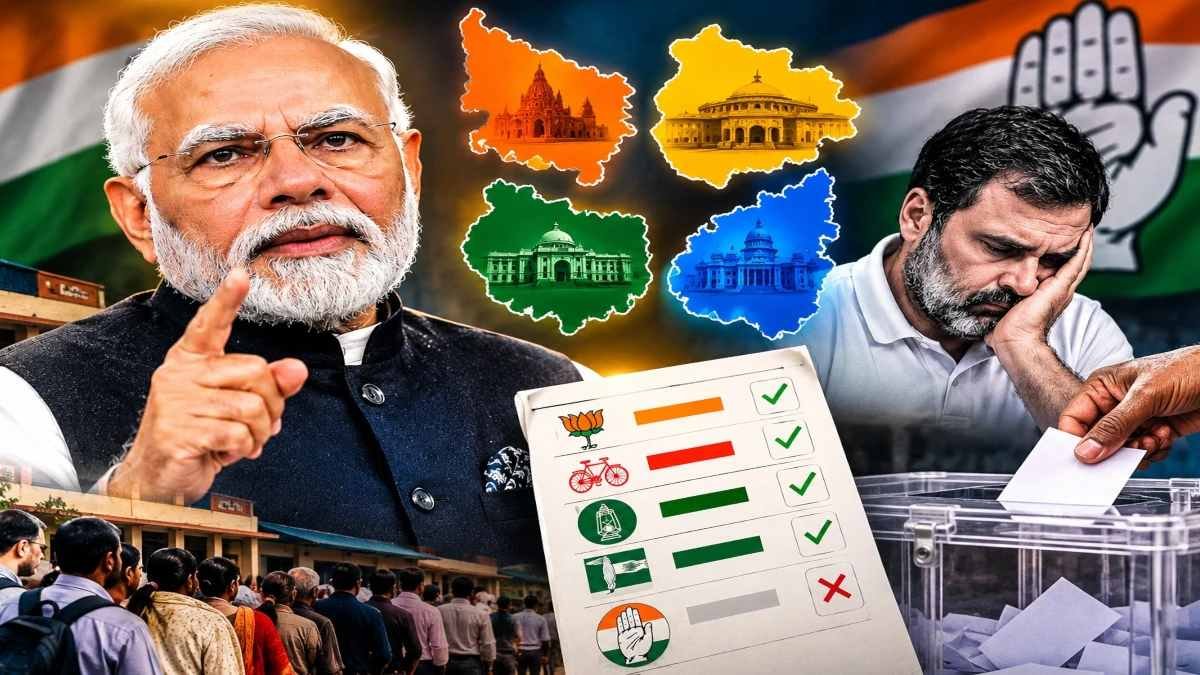
Prime Minister Narendra Modi publicly challenged the Opposition's long-standing campaign against electronic voting machines following the declaration of Legislative Council election results across 28 seats in four states. The elections in Uttar Pradesh, Maharashtra, Bihar, and Karnataka were conducted using paper ballots and ballot boxes rather than electronic voting machines.
Following the declaration of results on October 28, Prime Minister Modi posted on X, pointing out that the polls were conducted via ballot paper and asking how many seats the Congress party had won. Congress failed to secure a single seat out of the 28 contested across the four states, losing all four seats it previously held in these constituencies.
Uttar Pradesh Legislative Council Outcomes
In Uttar Pradesh, elections were held for 11 Legislative Council seats representing teachers' and graduates' constituencies. The Bharatiya Janata Party secured six seats, while the Samajwadi Party won three seats. The BJP recorded victories in key constituencies including Meerut and Bareilly. In Gorakhpur, BJP candidate Dhruv Tripathi secured victory by a margin of 307 votes, marking his fourth consecutive term as a Member of the Legislative Council.
Following the Gorakhpur result, independent candidate Rajeev Yadav alleged vote theft during the counting process. Congress did not win any seats in the state, drawing zero victories across both teachers' and graduates' constituencies.
NDA Wins All Four Seats in Karnataka
The National Democratic Alliance secured all four Legislative Council seats contested in Karnataka, despite Congress holding power at the state government level. In the Bengaluru teachers' constituency, Janata Dal (Secular) candidate AP Ranganath, running with BJP support, defeated sitting Congress MLC Puttanna by 908 votes. Ranganath received 10,810 votes compared to Puttanna's 9,902 votes.
In the North-East teachers' constituency, BJP candidate Shashil G Namoshi defeated Congress candidate Sharanappa Mattur by a margin of 3,297 votes. Namoshi polled 15,596 votes against Mattur's 12,299, securing his fifth consecutive victory in the constituency. Congress lost the single seat it previously held in the state among these constituencies.
Results from Bihar and Maharashtra
In Bihar's contest for eight MLC seats, the BJP, Janata Dal (United), Rashtriya Janata Dal, Jan Suraaj Party, and an independent candidate won one seat each. JD(U) candidate Neeraj Kumar won the Patna graduates' seat, while BJP candidate NK Yadav secured the Kosi graduates' seat for the third consecutive time. Congress failed to open its account across all eight seats in Bihar.
In Maharashtra, where 182 candidates contested three graduates' and two teachers' constituencies, results yielded a split outcome between the ruling Mahayuti and the Opposition Maha Vikas Aghadi:
- BJP candidate Kaustubh Gawade won the Pune teachers' seat.
- Kiran Sarnaik of the Shiv Sena (Eknath Shinde faction) won the Amravati teachers' seat.
- Pratapsinh Patil of the Nationalist Congress Party (Sharad Pawar faction) defeated Satish Chavan in the Chhatrapati Sambhajinagar graduates' seat.
- Harshada Deshmukh-Jadhav of the NCP (Sharad Pawar faction) won the Pune graduates' seat.
- Counting continued for a close contest in the Nagpur graduates' seat between BJP's Sudhakar Kohale and Congress's Abhijit Wanjari.
Congress did not secure a confirmed win on any seat in Maharashtra.
Reactions and Political Debates
BJP national spokesperson Sudhanshu Trivedi stated that the election results proved Congress lacked public support regardless of the voting method. He argued that allegations of vote theft were raised by the party to divert attention from its electoral performance, noting that the voting was conducted entirely using ballot papers and boxes.
The Opposition has frequently questioned the reliability of electronic voting machines and demanded a return to paper ballots in general elections, citing concerns over machine tampering. Electronic voting machines have been utilised in major Indian elections since 2000, accompanied by Voters Verifiable Paper Audit Trail verification. The Election Commission of India has consistently maintained that the machines are secure against tampering.